The S&P made a new high. That is when we get careful.
By Stephen Manning, President, Cash Flow University · · 7 min read
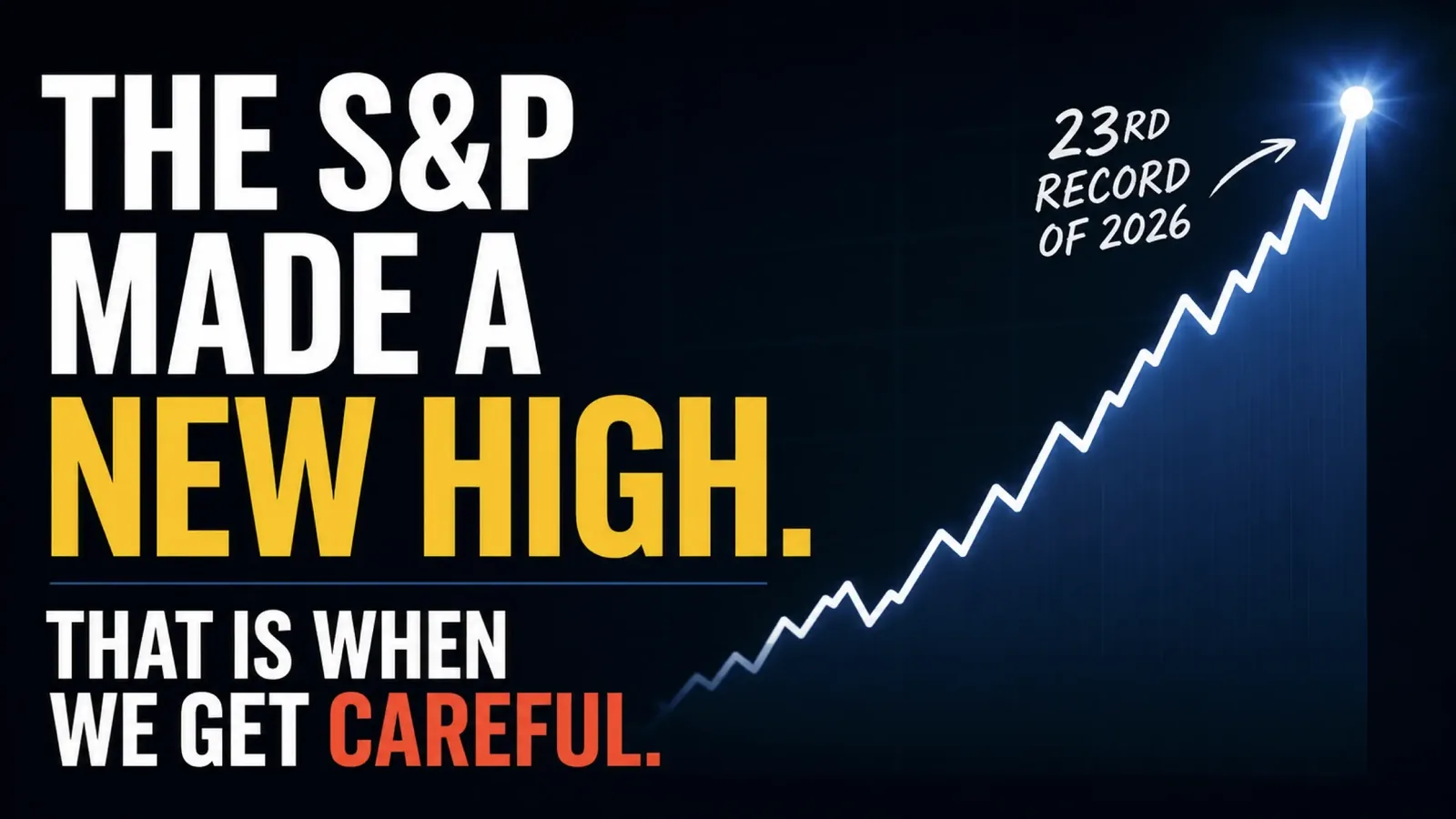
The S&P 500 just set its 23rd record of 2026. Put credit spreads are 31% of every trade we have ever placed, and a record high is the easiest place to get them wrong. Here is what one in four of ours actually needed.
The S&P 500 set its twenty third record of 2026 on the 4th of August. Put credit spreads are 31% of every trade we have ever placed, and a record high is the easiest place in the market to get them wrong.
On the 4th of August the S&P 500 set a record, the twenty third time it has done that in 2026. Most of what you read about that was some version of congratulations.
This is not that. A record is genuinely good news if you hold stock. It is also the exact condition under which the strategy we use most is easiest to get wrong, and we would rather say so out loud now than let you work it out the hard way in October.
The strategy we lean on hardest
Put credit spreads are 31% of every trade we have ever placed. Three hundred and forty seven of them are closed and sitting in the audited record. Fifteen are open right now.
A put credit spread is a bet that a stock will not fall much before a set date. You take a credit up front and you keep it if the stock stays above your strike. It is the closest thing in options to collecting rent, and that is precisely the problem.
At a record high the bet feels close to free. Nothing has fallen in a while. Implied volatility is usually low, so the premium is thinner. The strikes you would naturally pick sit a long way below anything that has recently hurt anyone. Every input on the screen agrees with you.
Thin premium is not the market being generous. It is the market saying it does not expect much to go wrong. It is usually right, which is why the strategy works at all. It is not always right, and the times it is wrong do not arrive politely spaced out.
Five largest of 69 open positions. Source: CFU published trade record.
What going wrong actually looks like
Here is the part almost nobody publishes.
Of the 347 put credit spreads we have closed, 259 did exactly what they were supposed to and needed nothing from us. Eighty eight did not. That is one in four.
All 347 closed put credit spreads in the record. 88 of them, one in four, needed at least one roll.
Most of the trouble was fixable in a single move. Fifty seven needed one roll and went away. Seventeen needed two. Eleven needed somewhere between three and five.
Three needed six or more.
The worst one we have had
A TSM spread opened on the 17th of December. The original expiry was the 26th of December, nine days later.
It closed on the 4th of June, having been rolled nine times, with the final expiry pushed out to the following June. Six months of management on a trade that was meant to take nine days.
We are not telling you that because it ended well, and we are not telling you because it ended badly. We are telling you because it is in the record either way, and because it is the honest answer to what happens when one of these turns on you. It does not blow up. It becomes a job.
The thing that separates people who last at this from people who quit is not picking the entry. Entries are the easy part and everyone teaches them. It is knowing what to do in month four.
What we did into PLTR
PLTR reported on the 3rd of August with a large move priced into the options.
The obvious trade into a setup like that is a put spread. Fat premium, a stock in a strong uptrend, a company that has beaten repeatedly. Everything about it invites you to sell puts.
We did not put one on. We opened a Jade Lizard.
A Jade Lizard is a short put paired with a short call spread, sized so the credit taken in covers the width of the calls. Built that way it carries no risk above the market. If the stock gaps up on a good number, the position does not mind.
That matters because the thing that hurts on an earnings beat is usually not the downside. It is being short the upside when a stock jumps ten percent overnight while you are asleep.
The point is not that a Jade Lizard is clever. It is that the structure was the decision and the direction was not. Direction is a guess wearing a suit. Structure is a choice, and it is the one you actually control.
If you are new, or still deciding
If you have just joined, or you have been reading us for months without joining, the useful takeaway is not an opinion about the S&P at a record.
It is this. Pick one structure. Run it until it bores you. And learn what you do when it goes against you before it goes against you, because it will, about one time in four.
That last part is the whole game. It is also why we would rather show you the one in four than quietly leave it out.
The record
The full record is audited by CSH Analytics, an independent third party, on a monthly and annual review of the raw record since April 2023. Losers are in it, which is the part worth checking.
Every number in this piece comes from the same place: a trade record we publish as trades close, audited by an independent third party. Members see it live, including the positions currently open and the ones going wrong.
If that is the way you want to learn, the room is open.
SEE THE RECORDNo signup needed to read it.
CFU holds an open position in PLTR at the time of writing. Figures above are counts of trades from our published record, not investment results. Past results are not a prediction of future results. Options carry risk including the total loss of premium paid. Nothing here is individual investment advice. Trade your own account at your own size.