Put Credit Spread Income Guide: Boost Your Earnings with Smart Options Trading
By Cash Flow University · · 4 min read

A comprehensive guide to generating sustainable income with put credit spreads. Learn stock selection, risk management with 25-35 delta targeting, the 80% profit exit rule, IV crush around earnings, and advanced techniques for consistent options income.
Navigating the World of put credit spreads: A Guide to Sustainable Income
Generating sustainable income through options trading can be a rewarding strategy, if executed correctly. Today, I want to walk you through put credit spreads, one of my favorite trading strategies due to its potential for steady income. This guide will cover what makes a good put credit spread, how to manage risks, and strategies for successfully exiting with a profit.
Watch the Full Breakdown
Understanding the Basics of Put Credit Spreads
Put credit spreads are an option trading strategy that flourishes in a neutral to bullish market environment. The goal is to identify stocks with a bullish trend or favorable market sentiment, signaling an upward trajectory. A prime example is the AI trade, where chip makers currently show strong performance while software stocks exhibit a bearish trend.
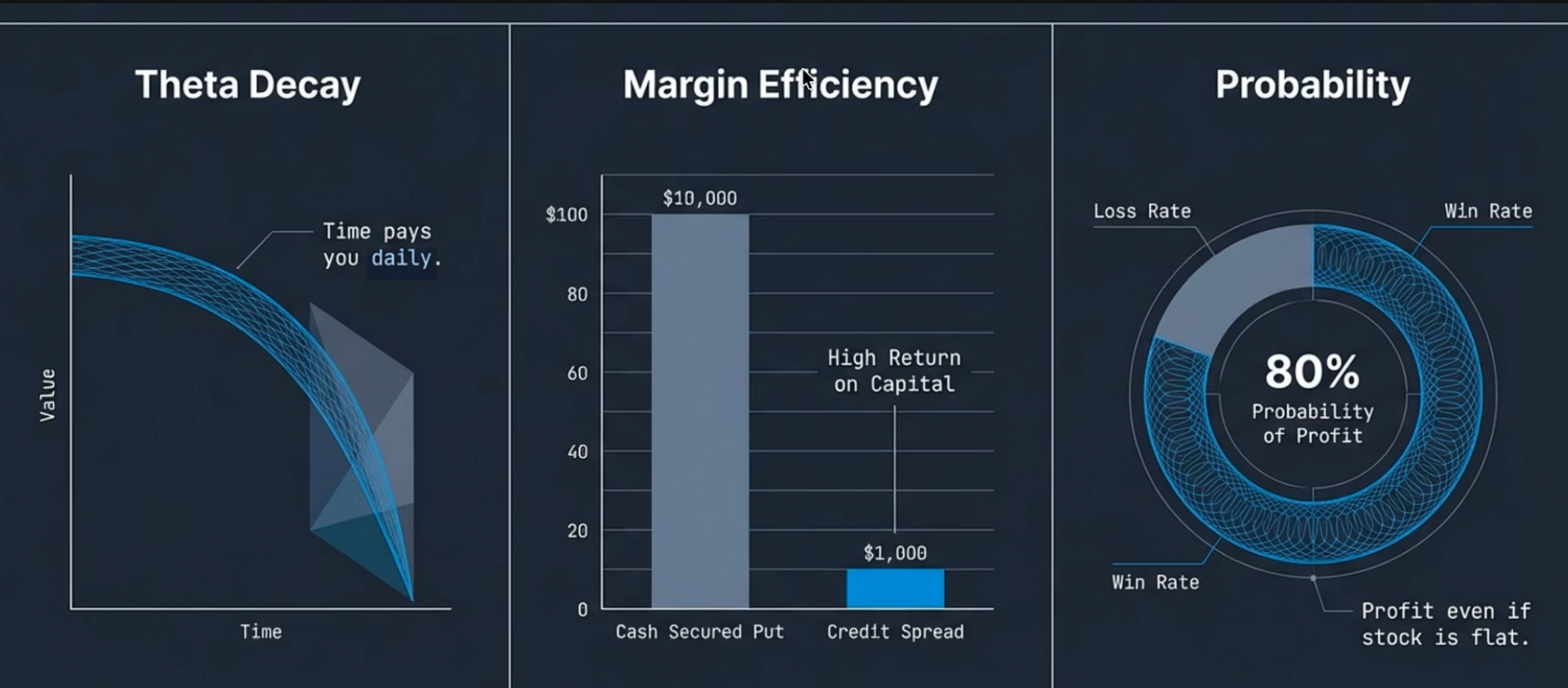
The allure of a put credit spread lies in its efficiency in capital deployment. With less capital than required for a cash-secured put, traders can use a put credit spread to capitalize on time decay and volatility crush. This strategy offers a defined risk and reward, making it appealing to traders looking for a balanced risk-to-reward ratio.
Strategies for Successful Execution
Selecting the Right Stocks
To maximize the chances of a profitable trade, focus on stocks with an upward trend and positive market sentiment. Chip makers, currently on an upward trend, represent an ideal opportunity to leverage these conditions. Avoid software stocks, which presently have a bearish bias.

Effective Risk Management
A successful put credit spread strategy requires proper risk management:
- Defined Profit and Risk: The strategy involves selling a more expensive put and buying a less expensive one, creating a profit and loss profile that caps both loss and potential gain.
- Striking the Right Balance: Choose deltas between 25 and 35 to maintain a balance between risk and reward. A tighter spread captures more premium, while a wider spread reduces risk.
Timing and Exit Strategy
Accurate timing is crucial when executing put credit spreads:
- Manage Risks Efficiently: Use techniques like rolling, where you can move strikes forward in time and lower positions, sometimes capturing an additional credit.
- Avoid Holding Until Expiration: Set an 80% profit target and exit trades to mitigate gamma risk, which accelerates as options near expiration.
💡 Pro Tip: The 80% Exit RuleWhen your put credit spread reaches 80% of its maximum profit, close the position. The remaining 20% of potential profit carries disproportionate risk because gamma accelerates near expiration. Taking profits at 80% keeps your win rate high and your risk exposure low.
Advanced Techniques and Considerations
Earnings and IV Crush
Trading around earnings can be lucrative due to IV crush, the rapid decrease in implied volatility post-earnings, which benefits option sellers. Entering trades close to earnings announcements allows traders to exploit elevated premiums.
📝 IV Crush StrategyImplied volatility typically spikes before earnings and drops sharply after. By selling a put credit spread before earnings, you can benefit from the premium compression even if the stock doesn't move much. Just make sure you are comfortable with the directional risk.
Pin Risk Management
Understanding pin risk is vital. Close trades before weekends to avoid unexpected moves after market hours that can result in unwanted assignments.
⚠️ Pin Risk WarningIf your short strike is near the stock price heading into expiration Friday, close the trade. After-hours moves can push the stock through your strike, resulting in assignment. The small remaining premium is not worth the risk of a surprise assignment over the weekend.
Conclusion
Put credit spreads offer an attractive strategy for generating income through defined risk and reward profiles. By selecting stocks with favorable trends, managing risks with techniques like rolling, and being mindful of timing, traders can enhance their profitability.
For those ready to embark on this trading journey, start small and gradually scale up as you become more familiar with the strategies and intricacies involved. Join communities like Cashflow University to share experiences and develop better trading practices.
🎯 Key Takeaways
- Put credit spreads thrive in neutral-to-bullish markets with defined risk
- Target deltas between 25-35 for balanced risk-reward
- Exit at 80% of max profit to avoid gamma risk near expiration
- Use rolling to manage challenged positions and capture additional credit
- IV crush around earnings creates opportunities for premium sellers
- Always close positions before expiration to avoid pin risk
Download My PCS Guide
Dive deeper into put credit spread mechanics, visual breakdowns, and real trade examples with our interactive presentation.
Download Guide →Leveraging these strategies and tips, traders can harness the income potential of put credit spreads while effectively managing the inherent risks. For more insights and trading systems, explore our community and discover the many ways to optimize your trading strategy.