Your broker will not let you sell that call. Here is why.
By Stephen Manning, President, Cash Flow University ·
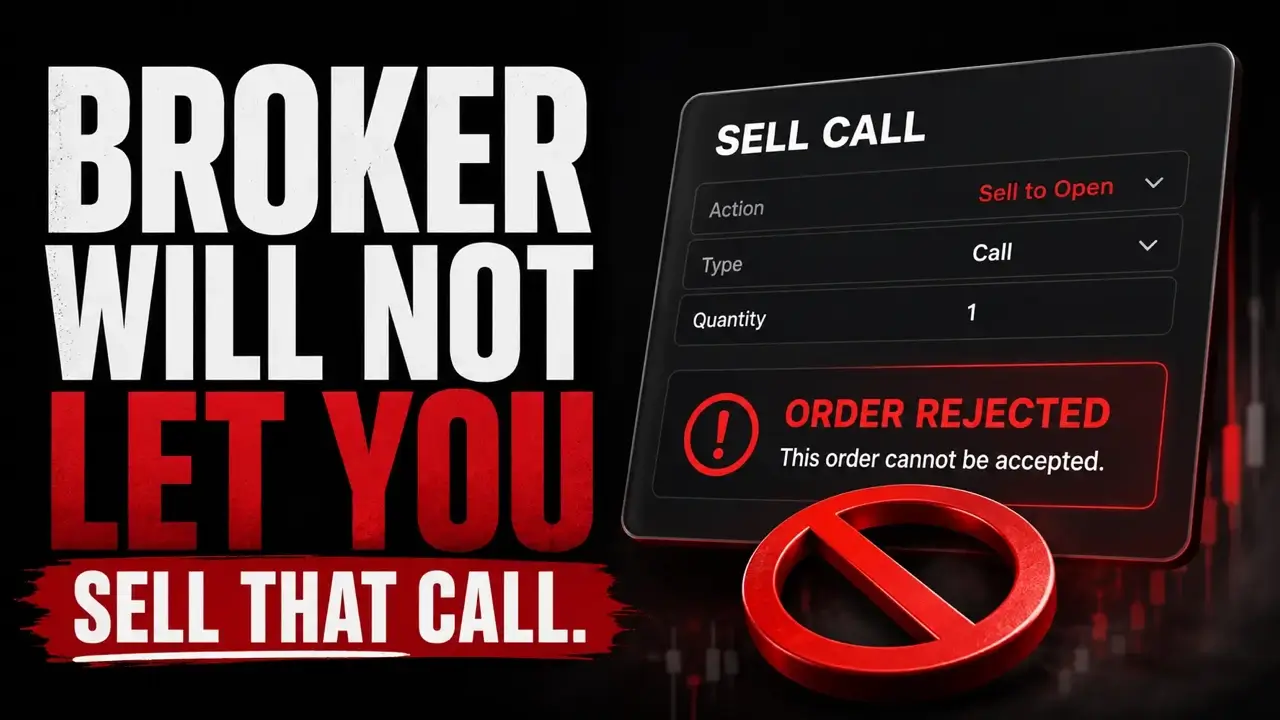
A member hit this yesterday: covered calls work fine, but the moment they tried to sell a call against a LEAPS the platform refused. Nothing was wrong with the account. The broker simply does not see that trade as a covered call, and the fix takes one phone call.
A member asked this in our Discord yesterday, and it is worth answering in public because almost everyone hits it eventually.
They had sold covered calls before with no trouble. Then they bought a LEAPS, went to sell a call against it, and the platform refused. Their account had options approval. Nothing was broken. The trade simply would not go through.
Here is what is happening.
Your broker is not looking at what you think it is looking at
When you sell a covered call, 100 shares sit in your account backing that call. If the stock runs past your strike, the shares get delivered. The broker's risk is closed. That is why the lowest option approval level covers it.
When you sell a call against a LEAPS, no shares back it. What backs it is another option. If the stock runs, your broker cannot deliver shares, it has to rely on you exercising a long call to cover the short one. That is a different animal with different failure modes, and brokers classify it as a spread rather than a covered call.
So the approval level that cleared your covered calls will not clear this. The account is fine. The category is wrong.
The fix
Call your broker and ask to be approved for spreads. At most firms this is the next level up from covered calls, it is a short form, and it is often same day. Once it clears, the position behaves the way you expected.
That is the whole fix. It is worth saying plainly because the failure looks like a broken account, and people quietly give up on a strategy when the platform tells them no.
What the structure is actually for
The combination has a name: a poor man's covered call. You buy a long-dated call instead of 100 shares, then sell shorter-dated calls against it for income.
Median days to expiry at entry across 116 covered calls, 14 PMCC positions and 60 LEAPS in our record.
That gap is the point. We buy LEAPS around 326 days out, and the calls we sell against them are measured in weeks. The long option is the position. The short call is the paycheck.
The appeal is capital. Buying 100 shares of an expensive stock ties up serious money. A long-dated call gives you a similar directional position for a fraction of it, and you can still sell calls against it.
Three honest things before you try it
First, this is not free income. Every call you sell caps your upside on the position underneath. If the stock runs hard, the short call is where your gains stop.
Second, our own LEAPS are not buy-and-hold.
The 48 closed LEAPS positions in our record. Median hold: 6 days.
Half of our closed LEAPS were closed inside a week. That surprises people who assume a 326 day option means a 326 day plan. We buy the time to have it available, not because we intend to use all of it. Buying time is not the same as needing it.
Third, the short leg needs managing. Eighteen percent of our 116 covered calls required a roll, against two percent of our LEAPS. The income leg is the part that demands attention, which is the opposite of what most people expect when they set this up.
If the platform says no
Ask for spread approval, and while you wait, sell covered calls on stock you already own or work put credit spreads instead. Neither needs the higher tier.
And if you are in a room where you can ask, ask. This particular wall costs people weeks, and it should cost them one phone call.
Where the numbers come from
Every figure is a count or a date from our published trade record, audited by CSH Analytics, an independent third party, monthly and annually since April 2023.
Every number in this piece comes from the same place: a trade record we publish as trades close, audited by an independent third party. Members see it live, including the positions currently open and the ones going wrong.
If that is the way you want to learn, the room is open.
SEE THE RECORDNo signup needed to read it.
Figures above are counts and timings of trades from our published record, not investment results. Past results are not a prediction of future results. Options carry risk including the total loss of premium paid. Option approval levels and their names vary by broker and change over time. Nothing here is individual investment advice, and nothing here is a recommendation about your broker. Trade your own account at your own size.