We close put credit spreads early. We let covered calls expire. Here is why.
By Stephen Manning, President, Cash Flow University · · 5 min read
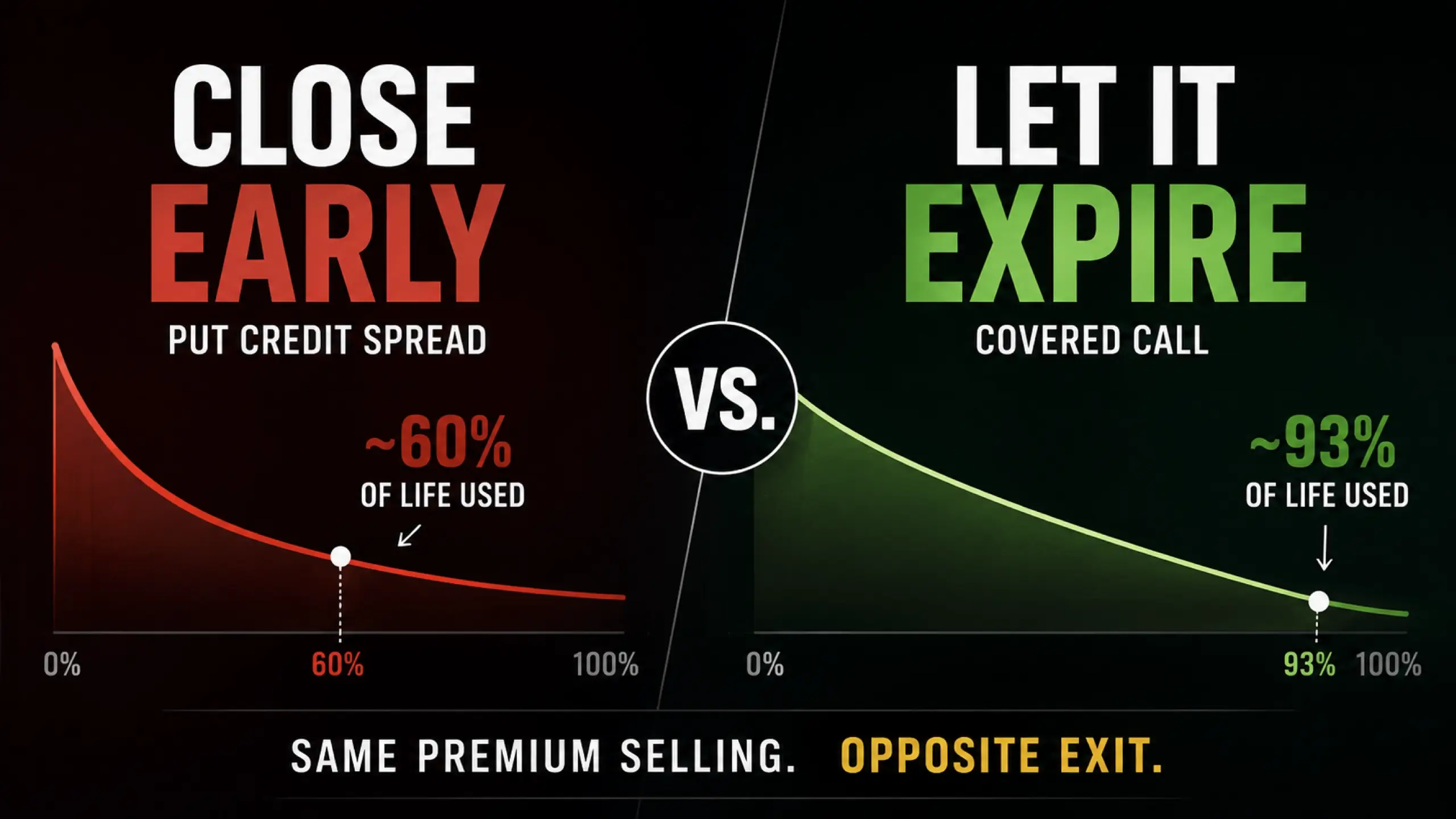
Both strategies sell premium. Both collect income. But across 1,137 closed trades we use 61 percent of the time we buy on one and 93 percent on the other, and treating them the same is one of the most expensive habits a new trader can have.
Two of our most-used strategies look like the same trade. Both sell premium. Both collect income up front. Both win when the stock behaves.
And we treat them completely differently.
Across every trade we have closed, a put credit spread gets bought around 28 days from expiry and closed around day 17. A covered call gets sold around 14 days out and held about 13. One gets closed with a third of its life left. The other runs almost to the end.
That is not inconsistency. It is the difference between the two trades, and it took us a long time to be disciplined about it.
The number, across every structure
Share of purchased duration held until close, by structure. Covered calls and iron condors are highlighted because they are the ones we let run.
Put credit spreads use about 61 percent of the time they bought. Covered calls use 93 percent. Iron condors average more than 100 percent because the short legs get rolled to a later expiry, which means the original duration was not enough.
The reason is mechanical. A put credit spread is a bet that the stock stays above a level. Once the spread has decayed, the remaining risk is small and the remaining reward is smaller. Holding it another week is mostly noise. A covered call is different. You already own the stock. The call is a way of getting paid while you wait. Letting it run closer to expiry captures more of the premium, and if the stock gets called away, that is part of the plan.
Why the same team closes one early and lets the other run
We publish every closed trade, so the pattern is visible if you look.
On a put credit spread, we are short a put and long a lower-strike put. The spread caps the risk. It also caps the upside. Once most of the premium is collected, the trade is doing what it was supposed to do. Closing it early frees capital and removes the tail risk of a late move.
On a covered call, we own the shares. The call premium is income, but the real position is the stock. We are not trying to time a perfect exit. We are getting paid to hold. Rolling or closing early usually only makes sense if the stock has moved hard against the call and we want to keep the shares.
Iron condors sit in the middle. They are short both a put spread and a call spread. The risk is the wings, and the wings get tested more often than a one-sided spread. That is why they roll more than anything else in the record.
Share of closed trades in each structure that required at least one roll.
The pattern here is worth sitting with. The structures with two short legs and defined risk need the most attention. Iron condors top the list at 28 percent. Cash secured puts need it least at 9 percent, because there is a simple fallback: you take the shares.
Covered calls sit low too, at 18 percent. That is part of why they are a reasonable place to start if you already hold stock, and why we point new members at them alongside put credit spreads.
The long positions barely appear. A LEAPS almost never gets rolled, because there is nothing pressing against it. It is also the structure people ask about most when they try to sell calls against a LEAPS.
The habit worth stealing
Before you open anything, decide which kind of trade it is.
If you were paid to take on risk and that risk shrinks as the premium decays, plan your exit early and mean it. Pick the fraction of premium you will take and leave the rest.
If you own the underlying and the option is a way of getting paid to wait, let it run and only intervene when the stock forces the question.
The mistake is not choosing wrong. It is having one exit rule and applying it to everything, which guarantees you are wrong on half your book.
Where the numbers come from
Every figure is a count or a date from our published trade record, audited by CSH Analytics, an independent third party, monthly and annually since April 2023. One structure in the record shows more than 100 percent of its life used, which simply means those trades were rolled past their original expiry.
Every number in this piece comes from the same place: a trade record we publish as trades close, audited by an independent third party. Members see it live, including the positions currently open and the ones going wrong.
If that is the way you want to learn, the room is open.
SEE THE RECORDNo signup needed to read it.
Figures above are counts and timings of trades from our published record, not investment results. Past results are not a prediction of future results. Options carry risk including the total loss of premium paid, and covered calls cap upside on the shares underneath. Nothing here is individual investment advice. Trade your own account at your own size.