Wheel vs LEAPS vs Poor Man's Covered Call: Which Options Strategy Is Best for You?
By Cash Flow University · · 8 min read

Compare three powerful options strategies: the Wheel, LEAPS, and Poor Man's Covered Call (PMCC). Learn which approach fits your capital, risk tolerance, and trading style with real examples and a detailed comparison matrix.
Look, when I first started trading options, the number of strategies felt overwhelming. I spent months bouncing between approaches, losing money on some, making it back on others. After years of trial and error, I keep coming back to three strategies that actually work: the Wheel, LEAPS, and the Poor Man's covered call (PMCC). Each has its place depending on your capital, risk tolerance, and what you're trying to accomplish.
I've traded all three of these for years now. Some I love. Some I've grown frustrated with at times. But I want to give you an honest breakdown of what I've learned through hands-on experience, not textbook theory.
The Wheel Strategy
The Wheel is probably the most popular income strategy in options trading. Here's the thing: it's basically just combining two strategies you probably already know. You sell cash-secured puts, and if you get assigned, you flip to selling covered calls. Rinse and repeat. Simple in concept, but the execution matters.
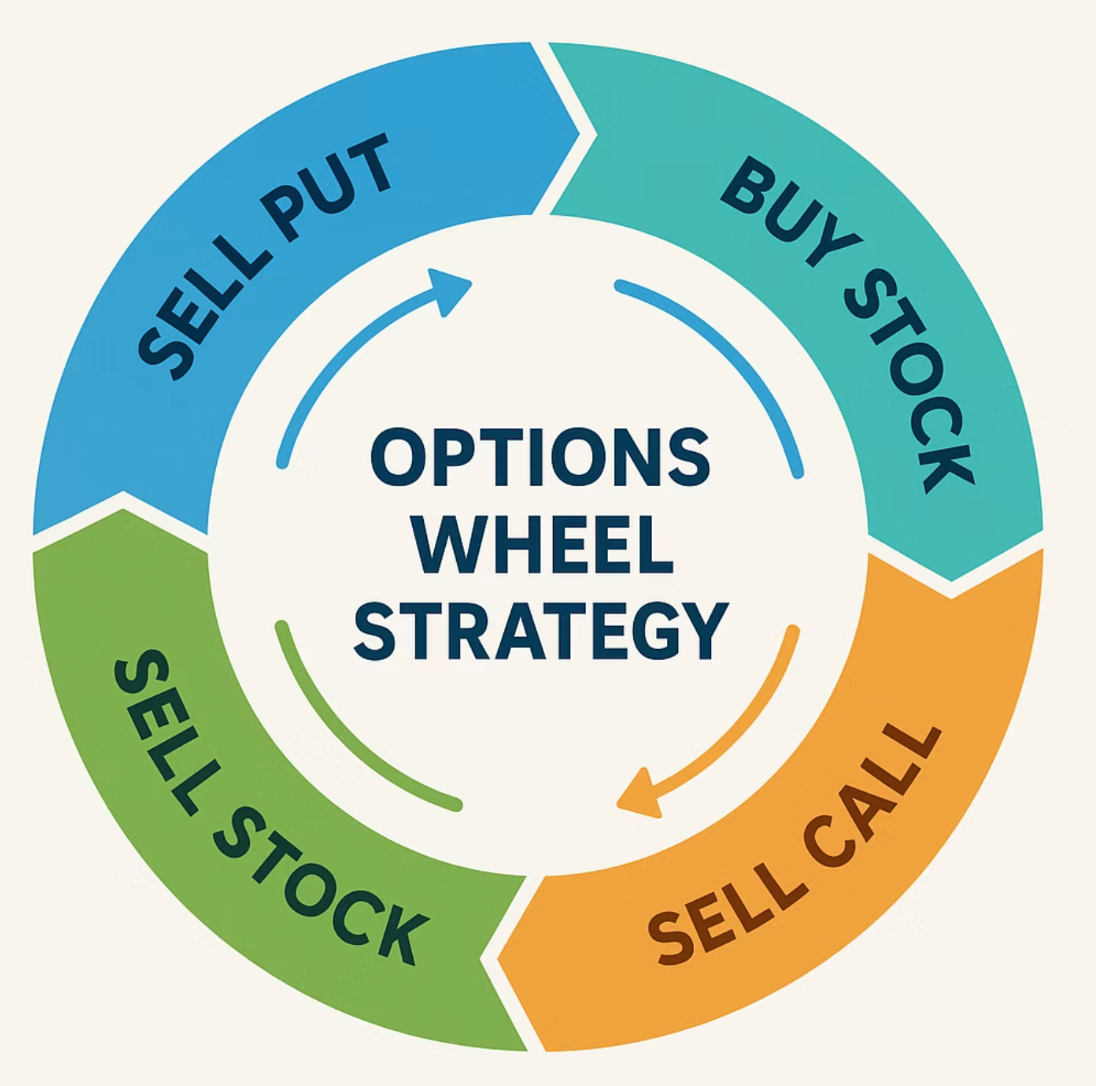
The Wheel Strategy: A continuous cycle of selling puts and covered calls
How It Actually Works
Step 1: Sell a Cash-Secured Put. Pick a stock you'd genuinely want to own. Sell a put, collect premium upfront. If the stock stays above your strike, you keep the money. Easy. If it drops below your strike? You buy the shares. That's not a loss, that's the plan.
Step 2: Get Assigned. Now you own shares, but at a discount. Your real cost basis is the strike price minus whatever premium you collected. Most traders see this as a feature, not a bug.
Step 3: Sell Covered Calls. You've got shares now. Sell calls against them. More premium. Your cost basis drops even further.
Step 4: Repeat. Shares get called away? Cool. Sell another put and start again.
Real Example: My Rigetti (RGTI) Trade
I ran this exact strategy on Rigetti (RGTI) last year. Volatile stock, which means fat premiums. I sold puts, got assigned, then sold calls for months. By the time I was done, I'd driven my cost basis down over 15% from where I first entered. Even with the stock whipping around like crazy, the premium I collected cushioned everything. Ended up profitable on a stock that would have crushed a buy-and-hold approach.
✅ What I Like About the Wheel
- Consistent premium income
- You buy stocks at prices you're happy with
- Dead simple once you understand it
- Works great in sideways markets
- Each cycle lowers your cost basis
❌ The Downsides
- You need real capital (100 shares per contract)
- Ties up margin while waiting for assignment
- If the stock craters, you're stuck holding bags
- You might miss huge rallies
- Realistically need $25K+ to do this properly
LEAPS: The Long Game
LEAPS are just options that don't expire for a year or more. Sometimes two or three years out. The appeal? You get leveraged exposure to a stock's movement without putting up the full cost of shares. Think of it like buying a 2-year lease on a Ferrari for the price of a used Honda. You get the speed, but if you don't use it before the lease is up, you walk away with nothing.
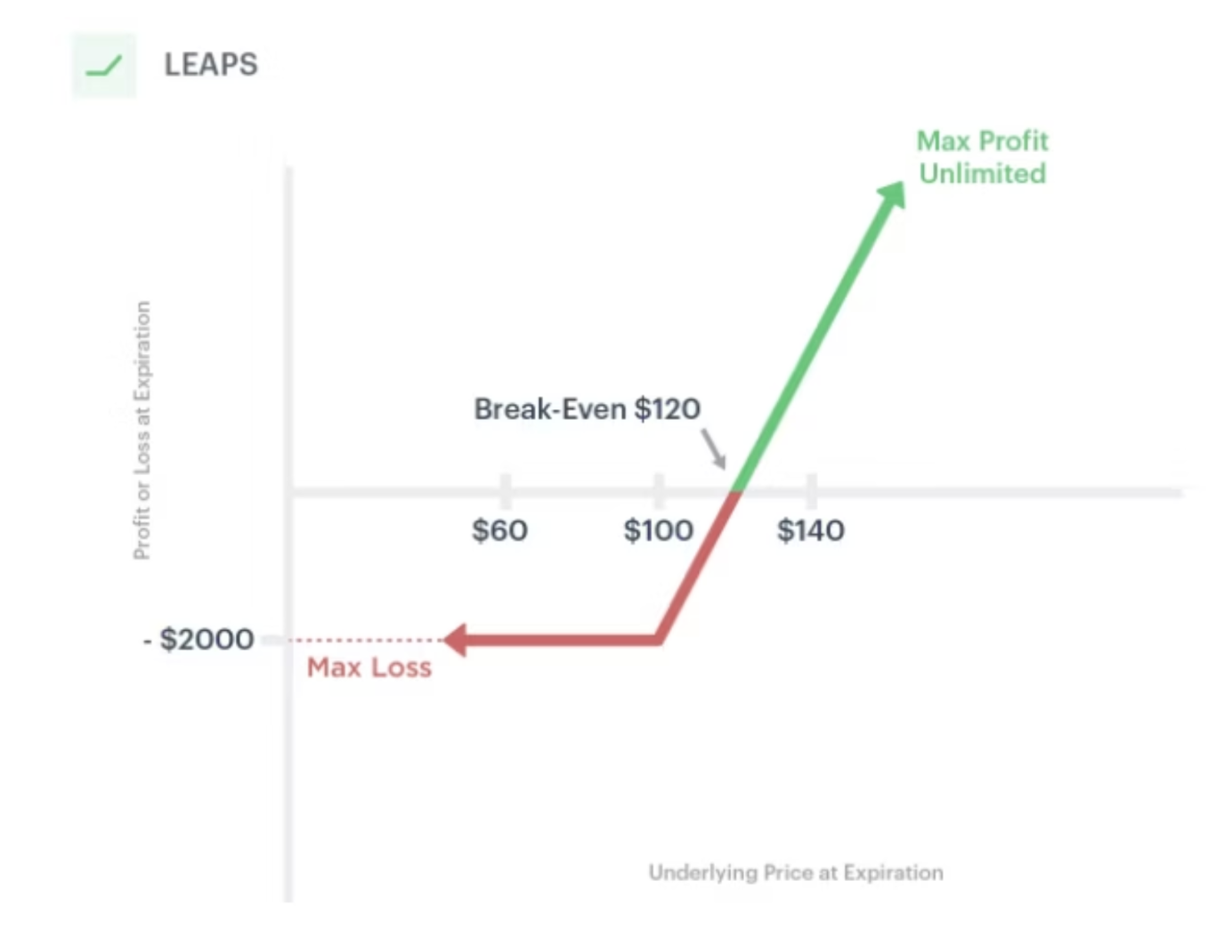
LEAPS Profit/Loss Profile: Limited downside, unlimited upside potential
Why LEAPS Work for Long-Term Plays
Regular options expire too fast. Your thesis might be right, but if the timing is off by a month, you lose everything. LEAPS give your idea time to breathe. If you're bullish on a company but don't want to tie up $50,000 in shares, a deep in-the-money LEAPS call might cost you $8,000-$12,000 while giving you similar upside exposure.
The big advantages: leverage with time (you control 100 shares for a fraction of the cost) and defined risk (your max loss is what you paid). That's it. You can't lose more than the premium.
My Novo Nordisk (NVO) Trade
I had great results with Novo Nordisk (NVO) as a LEAPS play. The thesis was simple: GLP-1 weight loss drugs were exploding, and NVO dominated that market. I didn't want to buy the stock outright, so I grabbed deep in-the-money calls with 18-month expirations. The stock ran. My LEAPS ran harder. I sold for a solid profit without ever owning a single share. That's the power of this approach: participate in big moves with way less capital at risk.
💡 Delta Selection Tip
When buying LEAPS as a stock replacement, I look for options with a delta of 0.70-0.85. This gives you solid price participation while keeping time decay manageable. The deeper you go in-the-money, the more your LEAPS acts like actual stock.
✅ What I Like About LEAPS
- Leverage without margin
- Lower capital than buying shares
- Time for your thesis to play out
- Max loss is capped at your premium
- Great for high-conviction plays
❌ The Downsides
- Premium can be expensive upfront
- Time decay still eats at you (slowly)
- No dividends
- Less liquid than stock
- You need to be right on direction
The Poor Man's Covered Call: Income on a Budget
Here's the thing about covered calls: they're great, but they require a lot of capital. Buying 100 shares of a $200 stock means locking up $20,000. The PMCC is basically renting to sublet. Instead of buying shares, you buy a LEAPS call as your "stock substitute" and sell shorter-dated calls against it. Same income strategy, fraction of the capital.
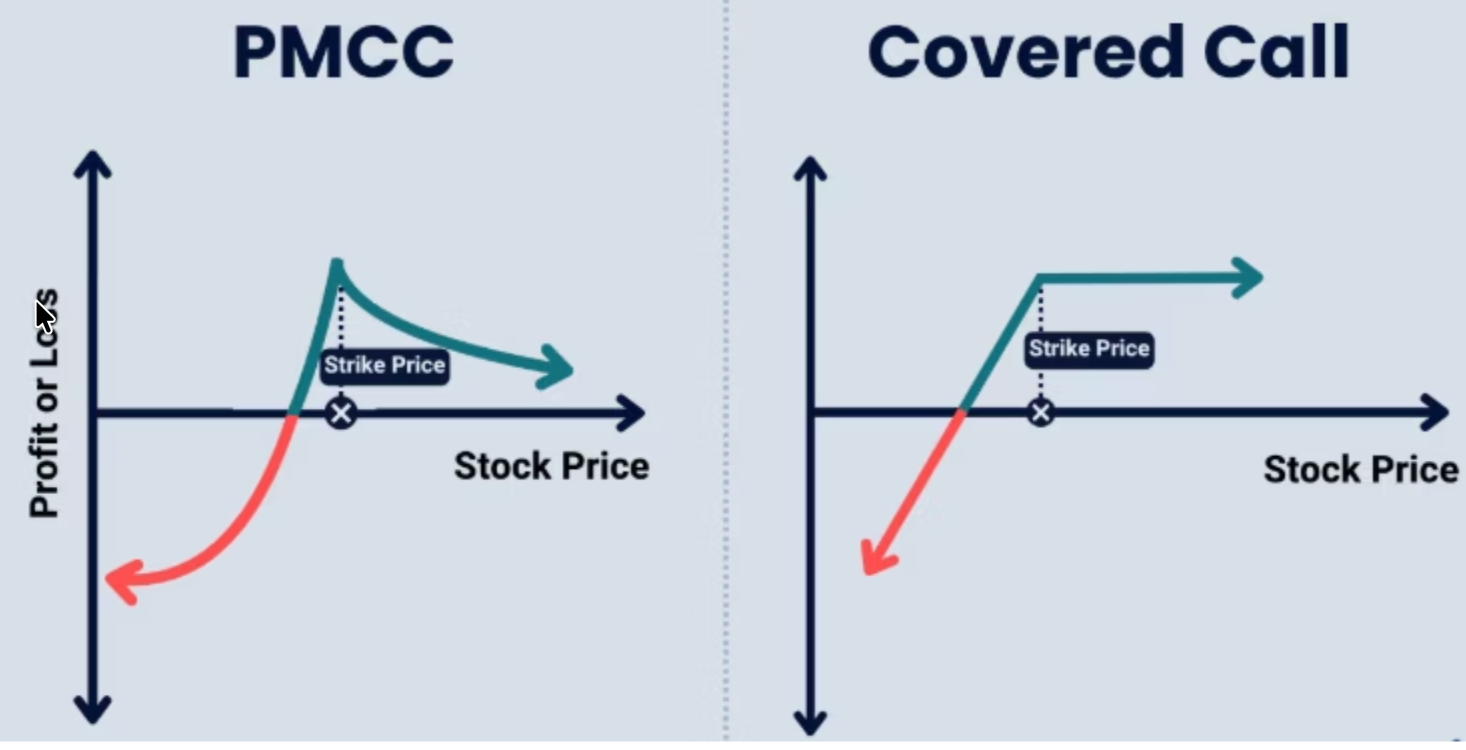
PMCC vs Traditional Covered Call: Same income strategy, fraction of the capital
How It Works
The Long Leg: Buy a deep in-the-money LEAPS call with a high delta (0.70-0.85). This is your stock substitute. It gives you the right to control 100 shares worth of movement.
The Short Leg: Sell shorter-dated, out-of-the-money calls against your LEAPS. This generates income just like a traditional covered call, but with 70-80% less capital tied up.
The Cycle: Short calls expire worthless or you close them for profit. Sell new ones. Repeat. Meanwhile, your LEAPS appreciates (hopefully) in the background.
Netflix PMCC Example
Let's use Netflix (NFLX) trading around $85. A traditional covered call needs $8,500 to buy 100 shares. With a PMCC:
- Buy: NFLX January 2027 $60 Call (LEAPS) for ~$32 ($3,200 investment)
- Sell: NFLX monthly $90 Call for ~$1.50 ($150 premium)
You've invested $3,200 instead of $8,500. That's a 62% reduction in capital while still collecting monthly premium. If you can pull in $100-$150 monthly, that's 3-5% return on your LEAPS investment. Every month.
✅ What I Like About PMCC
- 70-80% less capital needed
- Higher percentage returns
- Max loss is defined
- Recurring income stream
- Perfect for smaller accounts
❌ The Downsides
- More moving parts to manage
- No dividend income
- Early assignment can mess things up
- Your LEAPS still has time decay
- Need to understand spreads and Greeks
Which Strategy Should You Actually Use?
Forget the textbook for a second. Here's my honest take on when to use each one:
My Honest Take
Use the Wheel if: You've got $25K+ and actually want to own stocks. It's perfect for retirement accounts where assignment is welcome, not scary. You're playing the long game and don't mind holding through volatility.
Use LEAPS if: You have a strong opinion on where a stock is headed over the next year or two. You want leverage without the stress of short-term options. Set it and forget it (mostly).
Use PMCC if: You love the idea of covered calls but don't have $50K lying around. You're comfortable with a bit more complexity. You want to maximize return on every dollar you put to work.
📝 A Note on IRAs
All three strategies work in retirement accounts. The Wheel is particularly popular in IRAs because you actually want assignment (you're buying shares at your price). PMCC might need Level 2 or 3 options approval depending on your broker. Check with Fidelity, Schwab, or TD Ameritrade for their specific requirements.
Go Deeper
I put together a presentation that walks through each strategy with visual examples and real trade setups. If you want the details, check it out:
🎯 Want to See These Strategies in Action?
Join Cash Flow University. You'll get real trade alerts, educational resources, and a community that's actively running these plays every week.
Get Your Free Starter Kit →Frequently Asked Questions
These three strategies changed how I approach the market. Whether you want steady income from the Wheel, leveraged growth with LEAPS, or capital-efficient income through PMCC, they all work. The trick is matching the strategy to your situation: your capital, your time, your risk tolerance.
If any of this clicked for you, come join us at Cash Flow University. We're running these strategies every single day.