The date is the trade
By Stephen Manning, President, Cash Flow University · · 11 min read
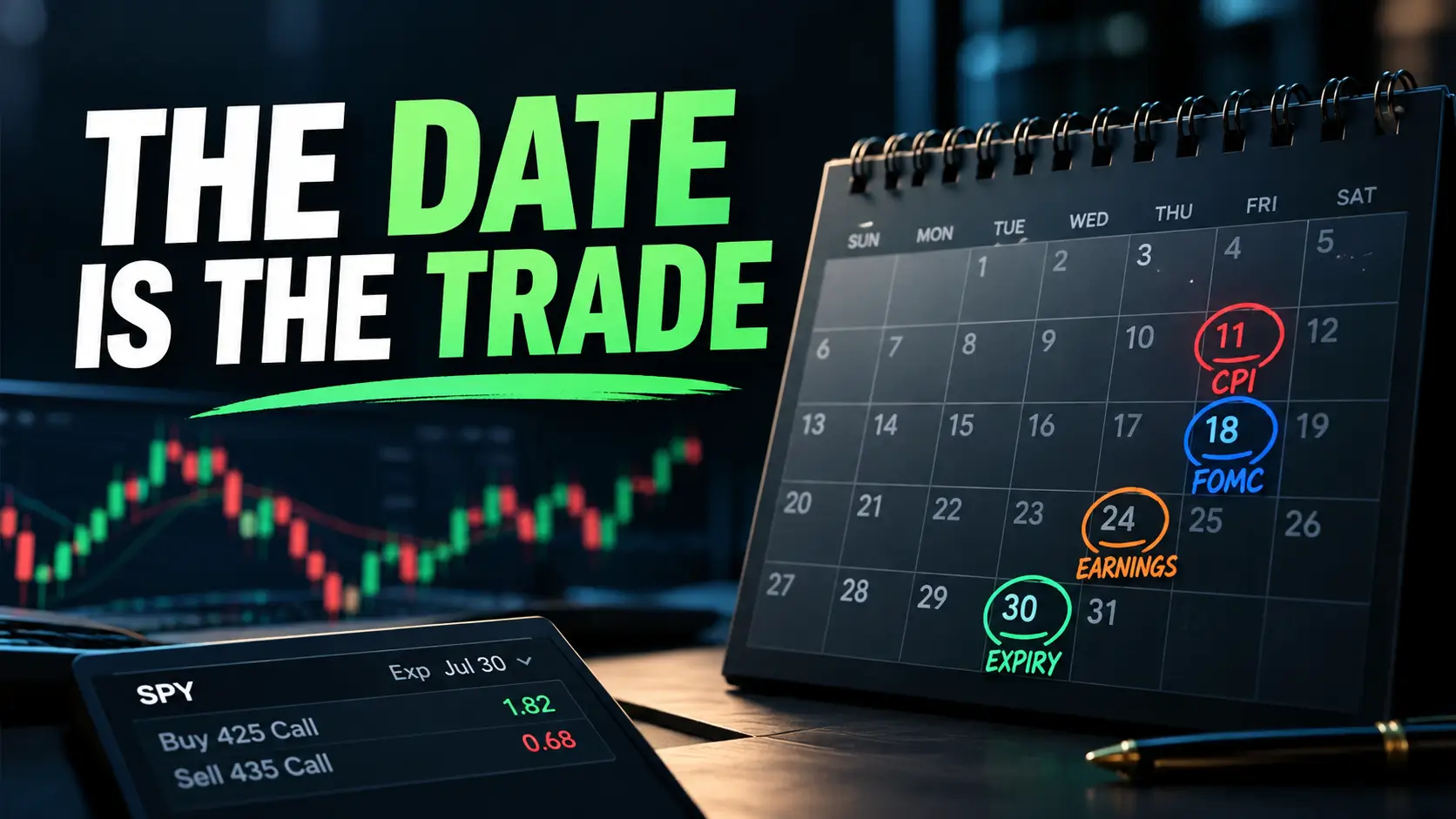
How we choose an options expiration around earnings, inflation reports and Fed decisions: one real trade, the calendar check, and what 420 closed trades can and cannot say about it.
How we choose an options expiration around earnings, inflation reports and Fed decisions.
On August 19 we sold a put credit spread on $AVGO, $5 wide, for $1.07. It expired on Friday, September 11, the morning the August inflation number came out. It made $107 at one contract.
That profit is the easy part to look at. The useful question is what we were prepared to lose if the number surprised the market. The answer was written down before the order went in: $393 per contract, the width of the spread less the credit. If Broadcom had gapped through both strikes on the print, that is what it would have cost, and I had decided that $393 against $107 was a price worth paying for those 23 days.
I want to be careful about what "written down" means. That $393 is the most an intact spread can lose if it is held to expiry. It is not a promise the market makes. A short put that finishes in the money can be assigned, and a spread left to the closing bell with the stock between the strikes needs managing rather than ignoring. The Options Industry Council's page on the bull put spread lays those risks out plainly. Our answer to them is procedural: when a short strike is threatened going into expiry week, we close or roll rather than wait to see.
Before any trade opens, we look at what sits between today and the expiration date. Here is how that calendar changes the decision, and what our own record can and cannot tell us about it.
The calendar check
Three kinds of dates get checked. Two belong to the company and one belongs to the whole market.
Earnings. We do not open a new short-premium trade whose expiry crosses the company's earnings report. Not the stock, the expiry. NVIDIA reported at the end of August; that stock has paid us thirty-eight times and we held nothing through the print. It is tradeable eleven months of the year.
The reason is not that the loss is undefined. It is defined, exactly as it was on $AVGO. The reason is what the trade turns into. A credit spread earns its money from time passing and from our ability to adjust while it does. An earnings gap removes both at once: the stock reopens somewhere else, and the position is either fine or at its maximum loss before the market opens, with nothing to manage in between. The premium is the fattest of the quarter because the market is pricing exactly that coin flip. We can size a coin flip. We would rather not buy one when the same stock in a different week is on the screen. Our scanner drops any candidate whose expiry crosses the earnings date before anyone reads it; on a recent scan that was one name of thirteen. Some days it is more, some days none.
Two things I should say plainly. That rule governs new entries. A position we are repairing can get rolled past an earnings date, and the $AAPL spread below is one; that is a different decision, made with the loss already on the table, and it should be called what it is. And the rule is not protection against a stock moving. It removes one scheduled way of being wrong overnight.
Macro dates. CPI is the monthly inflation report from the Bureau of Labor Statistics, out at 8:30 Eastern; its release calendar is public and worth checking rather than assuming. FOMC is the Federal Reserve committee that sets interest rates and announces a decision eight times a year. These hit every stock at once. We do not avoid them, because you cannot run an options book that hides from the calendar twenty days a year, but a position open across one gets sized as if the day can go either way. On the morning of the September Fed decision I put it this way to members: defined risk means we knew our worst case before Powell did. That is true of an intact spread. It is not a reason to stop paying attention.
Company events. Product days, investor days, a new chief executive's first keynote. Smaller than earnings, still scheduled, still worth knowing about before the order goes in.
Two trades, two calendars
The same week in September held both kinds of date: Apple's keynote on Wednesday the 9th, the CPI print on Friday the 11th. We had a position open through each, and they asked for different things.
The $AVGO spread was the simple case. Opened 23 days out, expiring on CPI day, so the report was the last thing that could happen to it. We knew that on August 19 and sized for it. Held to expiry, both puts expired worthless.
The $AAPL position is the messier one, and I would rather show it than tidy it. It began on March 13 as a $5-wide call credit spread expiring June 18, a wing added against another Apple position. In late May it was rolled out to December 18 and widened to $15. So by the keynote it had been open six months with three more to run, after one repair, and its current expiry crosses Apple's next earnings report, expected October 28. On the afternoon of the keynote there was nothing to do: with a hundred days left, one afternoon of headlines does not force a decision, though the stock can still move against us. The date that position answers to is not September 9. It is October 28, and we will have decided what to do with it before then.
How far out we start
Our median credit spread this year was opened 24 days from expiration. A quarter started at 11 days or fewer, a quarter at 35 or more. The distance is a choice, and it is the same choice as the calendar check seen from the other side.
A quarter of these spreads opened with 11 days or fewer, a quarter with 35 or more. Long calls and other structures are left out here; the 56 positions we opened with more than two months of runway this year were mostly long calls, a different decision.
Three months of runway turns a single event into one afternoon among many, which is why the $AAPL spread could sit through a keynote. A same-week expiry makes the event the whole trade, which is why the $AVGO spread had to be sized as if CPI could go either way. Neither is wrong. What is wrong is opening a five-day spread on a Monday without noticing that Wednesday is a Fed decision.
The 347-spread walkthrough from earlier this summer showed the typical shape: opened about 26 days out, closed around day 17, before expiry week arrives. Most of our spreads never meet their expiration date. The date still decides what we are willing to sell.
What the record shows, and what it does not
I pulled every 2026 trade that has closed, 420 of them, and asked a narrower question than I asked in the first version of this post: was the trade actually open on a CPI or Fed date? Not "did it expire near one", which turns out to include 71 trades that were closed before the event arrived. Open across it.
Net at one contract: $23,496 across the 249 exposed trades, $23,141 across the 171 others. Credit spreads only: 11 losers in 103 exposed, $35 a trade, against 4 in 53 and $67. Interpretation is in the text; these bars describe this sample and nothing more.
Read plainly: the trades that were open across a scheduled macro date lost more often, 23 of 249 against 6 of 171, and made less per trade. That is the opposite of the comfortable reading, and the opposite of what the first version of this post said. It does not show that the announcements caused the losses. The two groups hold different things: a longer-dated position is far more likely to sit across an event simply because it is open longer, and the losers in the exposed group include four long calls and four covered calls, structures that answer to the stock rather than the calendar. Credit spreads on their own show the same direction at a smaller scale. One contract each also does not mean equal dollars at risk. So I am not claiming events hurt. I am saying our record gives me no basis to claim they are free, and this version says what the data supports.
The narrowest cut is the 25 trades whose expiration fell on a CPI release day itself. Thirteen were closed before the number came out, which is our usual habit. Twelve were still open at 8:30 that morning, and all twelve won, $1,398 at one contract. Twelve is a small number and I would not build anything on it. It shows what one of these mornings looks like when the worst case was known in advance: small money, no drama.
Show all 25 trades
| CPI day | Ticker | Structure | Closed | Result |
|---|---|---|---|---|
| 13 Feb | $CRM | Put Credit Spr. | 02-13 | $45 |
| 13 Feb | $HOOD | Cash Secured Put | 02-13 | $350 |
| 13 Feb | $HOOD | Covered Call | 02-13 | $98 |
| 13 Feb | $ON | Strangle | 02-13 | $81 |
| 13 Feb | $PLTR | Covered Call | 02-13 | $200 |
| 13 Feb | $SMR | Jade Lizard | 02-06 early | $26 |
| 13 Feb | $TSLA | Put Credit Spr. | 02-11 early | $130 |
| 11 Mar | $SPX | Iron Condor | 03-11 | $80 |
| 10 Apr | $AMD | Put Credit Spr. | 03-25 early | $100 |
| 10 Apr | $ASTS | Call Ratio Spr. | 04-08 early | $169 |
| 10 Apr | $DELL | Cash Secured Put | 04-02 early | $113 |
| 10 Apr | $DLTR | Strangle | 04-10 | $164 |
| 10 Apr | $GLD | Iron Condor | 04-10 | $36 |
| 10 Apr | $GLD | Call Credit Spr. | 04-10 | $34 |
| 10 Apr | $HIMS | Covered Call | 04-19 | $64 |
| 10 Apr | $MRNA | Strangle | 04-10 | $139 |
| 10 Apr | $NVDA | Covered Call | 04-02 early | $95 |
| 10 Apr | $SPY | Call Credit Spr. | 04-02 early | $29 |
| 10 Apr | $TSLA | Covered Call | 04-02 early | $133 |
| 12 Aug | $SPY | Put Credit Spr. | 08-07 early | $30 |
| 11 Sep | $AVGO | Put Credit Spr. | 09-11 | $107 |
| 11 Sep | $CRWD | Cash Secured Put | 08-27 early | $256 |
| 11 Sep | $CRWD | Put Credit Spr. | 08-27 early | $76 |
| 11 Sep | $ORCL | Strangle | 08-28 early | $232 |
| 11 Sep | $UPS | Strangle | 08-31 early | $144 |
All 25 won. Twelve were still open at 8:30 Eastern on the release day and made $1,398 between them; thirteen had been closed earlier, in line with our habit of taking profits before expiry week. Nothing expired on a Fed decision day itself, which is a Wednesday.
One trade in the exposed group is the most useful one in this post, for a reason that has nothing to do with the calendar.
Three questions before you click
- Does this expiration cross an earnings date for this stock? If yes, pick a different expiration. Not a different stock.
- Which scheduled dates fall between today and expiration? Check the CPI calendar and the FOMC calendar rather than working from memory. Know which ones you are carrying.
- Can you hold the written-down worst case at one contract through all of them without it changing your week? If not, the trade is too big, not too risky.
Then one thing to do this week: take a position you already hold and write those three answers next to it. If any of them surprises you, that is the trade to look at first.
Every trade in this piece is in our public record, dated, with the losers next to the winners and an independent monthly review. Look up the $AVGO spread, the open $AAPL position and the $LULU loss.
SEE THE RECORDNo signup needed to read it.
Figures are per contract at one contract per trade, before any commissions, from the tradebook as of September 24, 2026. Past results are not a prediction of future results. Options carry risk including the total loss of premium paid, and a spread can be assigned or need managing at expiration. Nothing here is individual investment advice. Trade your own account at your own size.