What Happens When a Put Credit Spread Goes Wrong
By Stephen Manning · @StephenCFU on X · · 11 min read
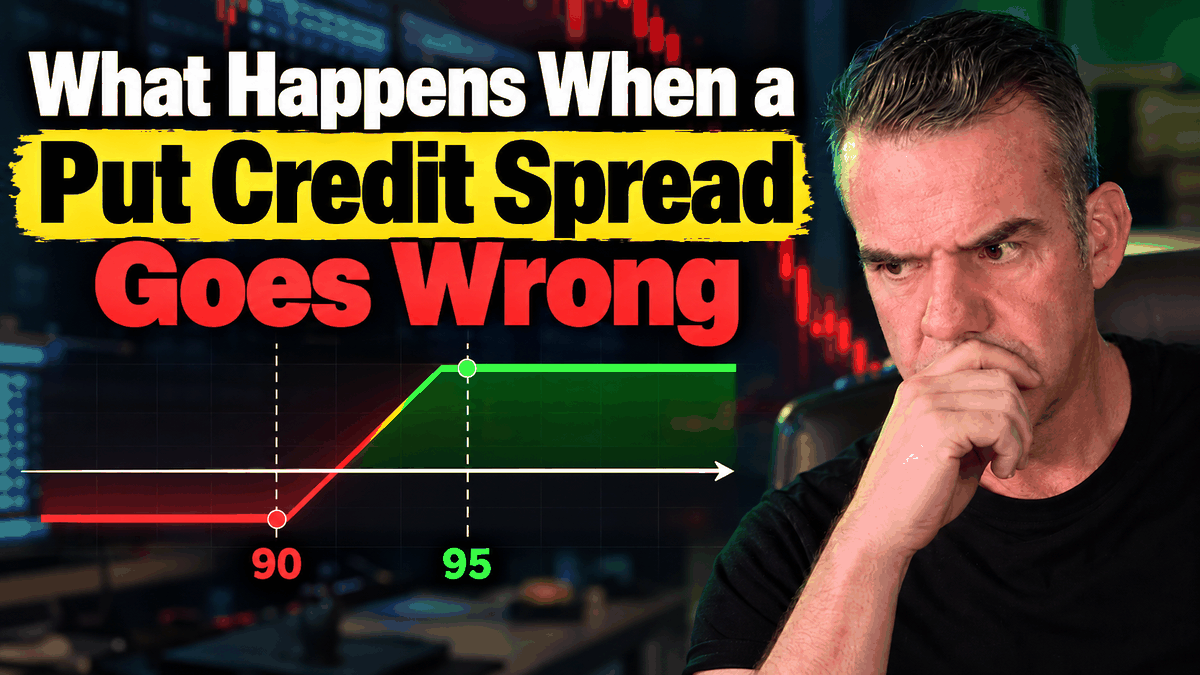
A put credit spread can lose more than the credit you collect. See the worst case in dollars, what a roll changes, and one META stock campaign that lost $215.
A put credit spread has a worst case you can work out before you open it, and that worst case can be bigger than the credit you collect. Rolling one closes the spread you have and opens a new one, and the loss on the first spread stays.
So you sold a put credit spread, and now the stock is dropping. You're looking at the loss on your screen and thinking about rolling it, pushing it out to a later date.
Before you roll, know what a roll actually does. It doesn't erase a loss, and a spread like this can lose more than the credit you collected.
I'm Stephen, from Cash Flow University. We sell put credit spreads, and some of ours have lost money. This is education, and none of it is advice.
Here's the plan: how a spread works, how it goes wrong, and what a roll changes. Then one trade from our record that lost money, and three questions to ask before you roll.
How does a put credit spread work?
A put gives its owner the right to sell 100 shares at a fixed price, called the strike, until a certain date, called the expiration. It gains value as the stock falls. Whoever sells the put gets paid a premium, and has to buy the 100 shares if the owner uses that right. That's called exercising it.
A put credit spread is two puts on the same stock with the same expiration. You sell the higher strike and buy the lower one. The higher strike put is worth more, so you take in money up front, called the credit.
Now an example. Model numbers only, round ones, before fees.
The stock is at $100. You sell the put with the 95 strike and buy the one with the 90 strike. You collect $1.50 a share. A contract is 100 shares, so that's $150.
That's the most you can make. You keep all of it if the stock finishes at 95 or higher on expiration day.
What is the most you can lose on a put credit spread?
In the model, the strikes are $5 apart, so the spread is $5 wide. Below 90, every dollar the stock falls costs you a dollar on the 95 put you sold, and earns you a dollar on the 90 put you bought. The two cancel out. So buying the spread back, which is called closing it, can never cost more than $5 a share.
$5 minus the $1.50 you collected is $3.50 a share. Times 100 shares, that's $350. That's the most you can lose, your worst case, if you hold the spread to the end. The most the spread can cost to close is its width, and you already took in the credit, so the worst case is the width minus the credit.
It's more than twice the $150 you can make, so you can lose more than the credit you collected.
Here is the model spread in one place:
| Piece | Model number |
|---|---|
| Stock | $100 |
| You sell | the 95 put |
| You buy | the 90 put |
| Width | $5 |
| Credit | $1.50 a share, $150 a contract |
| Max gain | $150 |
| Max loss | $350 ($5 minus $1.50, times 100 shares) |
| Break‑even | $93.50 (no gain, no loss at expiration: the 95 strike minus the $1.50 credit) |
How does a put credit spread go wrong?
There are three ways. The stock can fall below your break-even and you hold to expiration, you can be assigned, or you can be down before expiration.
All three use the same model spread: sell the 95 put, buy the 90 put, and take in $1.50 a share.
What is the break-even on a put credit spread?
Break-even is the strike of the put you sold minus the credit. On the model spread, that's $93.50, the 95 strike minus the $1.50. That's where you end up with no gain and no loss.
At $93.50 on expiration day, the 95 put is worth $1.50, so closing costs $150. That's exactly the $150 you collected. Above it, you keep at least part of the credit. At 90, you're down $350, and below 90 it stays there.
Valued at the close on expiration day, before fees, the model spread ends up like this:
| Where the stock finishes on expiration day | Result for the model spread |
|---|---|
| $95 or higher | $150 kept |
| $93.50 | $0 |
| $92 | Down $150 |
| $90 or below | Down $350 |
At $92, the 95 put is worth $3, so closing costs $300. You collected $150, so you're down $150.
If the stock finishes anywhere from 90 up to just under 95, the put you sold will likely be exercised, and the put you bought expires worthless. That's assignment, covered next. The results in the table are the value of the spread at that close. After an assignment you own 100 shares, and your result moves with them.
What is assignment on a put credit spread?
Assignment is when the owner of the put you sold exercises it, and you have to buy 100 shares at 95. That puts $9,500 of stock in your account, and your account has to cover it.
With US stock and ETF options, that can happen before expiration, and you don't get to choose when. Once you're assigned, the put you sold is gone and you own the shares.
The put you bought still lets you sell the shares at 90. Selling at 90 loses $5 a share, and the $1.50 credit brings that down to $3.50, or $350. That keeps the loss at $350, but only if you use that put. Your broker may not exercise it for you.
You can also be assigned on the last day. If the stock finishes at 92, the put you sold will likely be exercised, and the put you bought expires worthless. Then you own the shares with nothing protecting them, and they can keep falling.
The only sure way to end the risk of assignment is to close the spread before expiration.
Can a put credit spread lose money before expiration?
Yes. On the model spread, say a week is left and the stock is at 93. Closing the spread would cost $240. You collected $150, so you'd lose $90.
On expiration day at 93, the 95 put is $2 in the money, so closing costs $200 and the loss is $50.
| Where the stock is | Cost to close | Result |
|---|---|---|
| A week left, at 93 | $240 | Down $90 |
| Expiration day, at 93 | $200 | Down $50 |
Break-even only counts on expiration day. With a week left, closing costs $40 more, because the stock still has time to fall.
That's where people start thinking about rolling.
What does rolling a put credit spread do?
A roll is two steps. You close the spread you have, then you open a new one with a later expiration. The loss on the first spread stays.
A roll that brings in a credit
Same model numbers, same situation: a week left, the stock at 93, and you're down $90.
Closing costs $240. You collected $150, so the $90 loss is now locked in.
Then you open the same strikes, 95 and 90, expiring 30 days after the old one, and collect $260. It brings in more because the stock is already below your 95 strike, and that also makes it more likely to lose.
Against the $240 you paid out to close, that's $20 coming in, called a net credit.
Don't count that $20 as profit. A net credit only says the new spread brought in more than the old one cost to close. The $90 you lost stays lost, and the new spread can still lose.
So why roll at all? The hope is that more time gives the stock a chance to come back, and it might not.
I'll call the whole run of spreads a campaign. Its result is every spread added together.
The new spread could lose up to $240, the $5 width minus $2.60 a share. Add the $90 you already lost, and the campaign's worst case is $330. That's $20 less than before the roll, the size of the net credit.
A roll that costs a debit
A roll can also cost money. Say the stock is at 91 instead. Closing costs $310, and the new spread brings in $290, which is $20 less than you paid to close. That's a net debit of $20, meaning you pay.
You collected $150 and paid $310 to close, so you've lost $160. The new spread can lose up to $210, the $5 width minus $2.90 a share. $160 plus $210 is $370, which is $20 more than before the roll.
Side by side, before fees:
| Step | Stock at 93 | Stock at 91 |
|---|---|---|
| Pay out to close | $240 | $310 |
| Take in on the new spread | $260 | $290 |
| Net of the roll | $20 credit | $20 debit |
| Lost on the first spread | $90 | $160 |
| Most the new spread can lose | $240 | $210 |
| Worst case, whole campaign | $330 | $370 |
| Worst case before the roll | $350 | $350 |
What happened when one put credit spread from our record was rolled?
One put credit spread in our trade record was rolled once, and the campaign lost $215 on one contract. Here's that campaign, from the record instead of the model.
The stock was Meta Platforms, ticker META. The record shows a put credit spread, $5 wide, expiring November 14.
On October 30, 2025, it was sold for $1.01 a share. That's $101.
On November 4, it was bought back for $1.60 a share, or $160, so the first spread lost $59.
That buyback was the first step of a roll. The second step, the same day, opened a new spread, also $5 wide, expiring a week after the first one, on November 21. It was sold for $1.74 a share, or $174.
So $160 went out to close, and $174 came in. That's a net credit of $14.
Three days later, on November 7, the second spread was closed. It cost $3.30 a share, or $330, to buy back, two weeks before it expired. It had been sold for $174, so the second spread lost $156.
| Step | What the record shows |
|---|---|
| Spread 1, expiring Nov 14 | Sold Oct 30 for $101, bought back Nov 4 for $160. Lost $59 |
| The roll, Nov 4 | $160 paid out to close, $174 taken in on the new spread. Net credit $14 |
| Spread 2, expiring Nov 21 | Sold Nov 4 for $174, bought back Nov 7 for $330. Lost $156 |
| The campaign | $59 and $156 added together. Lost $215 |
Now add the spreads. $59 lost on the first. $156 lost on the second. The campaign lost $215.
Don't add the $14 credit on top. It's already inside both losses. The roll brought in $14, and the campaign still lost $215.
Check it from the cash side. $160 and $330 went out, for $490. $101 and $174 came in, for $275. $490 minus $275 is $215.
Options carry risk of loss, and past results aren't a promise.
What should you ask before rolling a put credit spread?
Here are three questions to ask before any roll: the worst case for the whole campaign, whether you'd want the new spread anyway, and where you stop.
- If you roll, what's the worst case for the whole campaign? Add what you've already lost to what the new spread could lose. That's your total risk.
- Would you want the new spread anyway? Set the loss you already have aside, because it's gone either way. If you were opening it fresh today, would you do it? That judges the new spread on its own.
- How many rolls will you do, and what loss makes you stop? Decide that before the roll, because every roll adds more days for the stock to fall.
Recap: what to remember
Related reading
Educational content. Not financial advice. Options carry risk of loss, and a seller's loss can be larger than the premium collected. Past results aren't a promise.