The AI Feedback Loop: How Chips, Productivity, and Palantir Can Compound Your Wealth
By Cash Flow University · · 6 min read

Explore how AI, technology, and companies like Palantir are shaping the future of wealth and productivity.

📌 Bottom Line Up Front
It is now clearer than ever that the market is being driven by a single, powerful, and self-reinforcing engine: the AI Feedback Loop. This isn't just another tech trend; it's a virtuous cycle connecting the global semiconductor supply chain, a historic surge in U.S. productivity, and the real-world deployment of AI applications that are fundamentally changing how business and government operate. This feedback loop is creating what I believe is a once-in-a-generation investment opportunity, and understanding its mechanics is the key to building compounded wealth over the next decade.
This isn't just a collection of scattered data points—it's one epic story. It's the story of how the world's reliance on fragile chip supply lines in Asia directly links to a productivity boom on Main Street, USA. It's the story of how advanced software from companies like Palantir is saving taxpayers billions, which in turn fuels more demand for the very technologies that power it.
Over the last few months, I've been connecting these dots, and this deep dive is the result. We're going to unpack this entire narrative, from the geopolitical chessboard of microchips to the almost magical power of compounding growth that could mint new fortunes.

Part 1: The Magic of Compounding — Your Blueprint for Generational Wealth
To truly capitalize on the AI revolution, we must first master the single most powerful force in finance: compounding. Before diving into specific technologies or companies, it's essential to build our strategy on this unshakable foundation. Market narratives come and go, but the disciplined application of compounding principles is what separates fleeting gains from generational wealth.
Demystifying the Compound Annual Growth Rate (CAGR)
CAGR measures the average annual growth rate of an investment over a specified period, assuming that all earnings are reinvested. Its greatest benefit is its simplicity; it smooths out volatile market fluctuations to give you a clear, standardized metric of an asset's growth path over time.
The Formula
CAGR = (Ending Value / Beginning Value)1/Years – 1
By applying this formula, you can distill years of complex performance into a single, comparable number that reveals the true rate of increase of a capital asset.
The Power of Compounding in Action
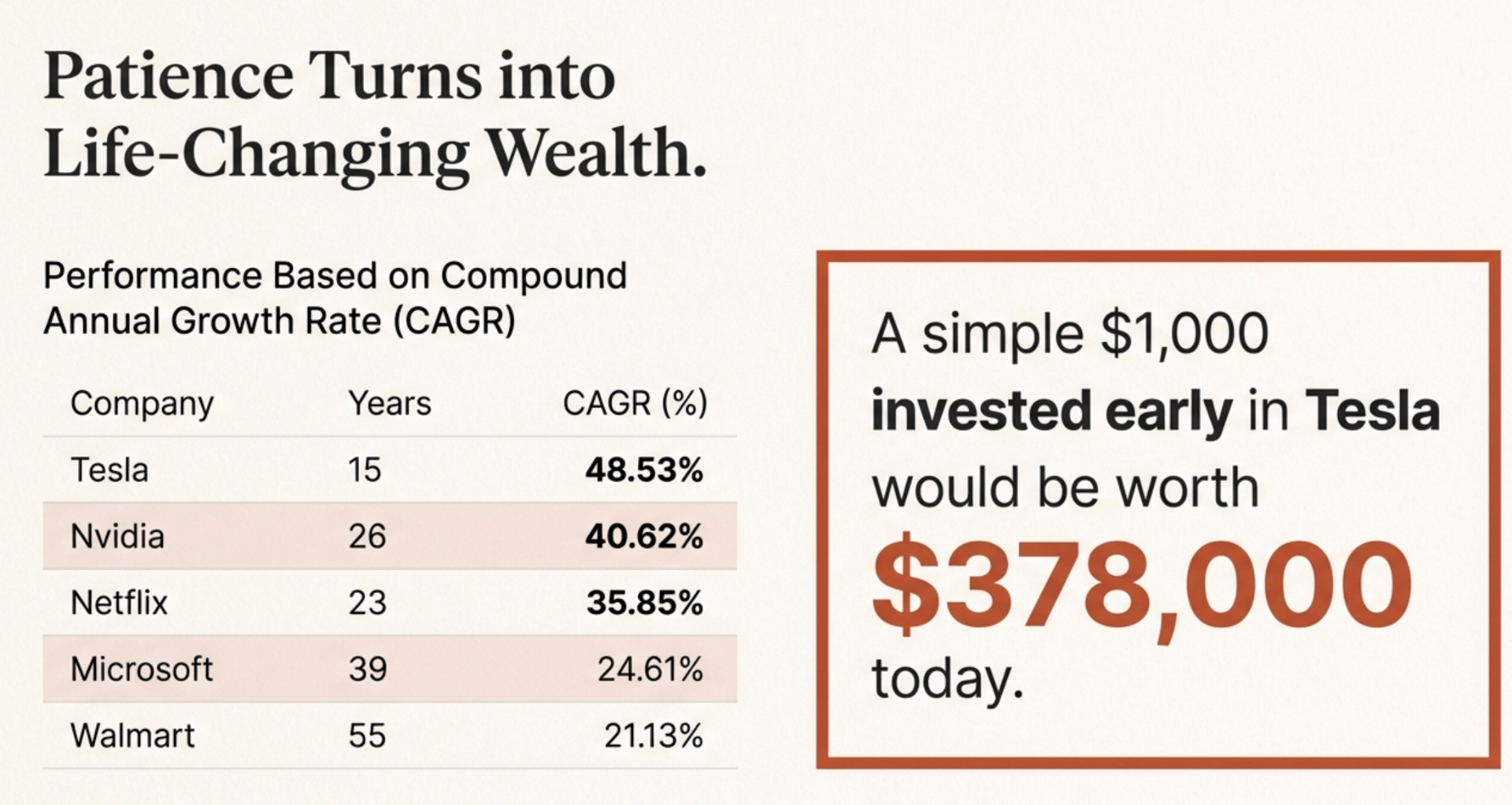
The "so what?" of this data is staggering. Tesla's 48.53% CAGR over 15 years turned a hypothetical $1,000 into $378,000—a clear example of hyper-growth compounding. The difference between a tech titan like Nvidia and a "boring" but incredibly consistent winner like Costco highlights the exponential power of sustained high growth.
💡 Key Insight: Over long horizons, a seemingly small difference of a few percentage points in annual CAGR can be the dividing line between a respectable return and true generational wealth, making asset selection paramount. Patience is the critical ingredient—volatility can shake out even the most ardent believers, but those who hold quality assets through market cycles are the ones who reap life-changing rewards.
Part 2: The Investor's X-Ray — How to Identify True Long-Term Compounders
In a market often driven by short-term narratives, identifying the companies that can create wealth for years to come requires a disciplined framework. It's not about chasing quick gains; it's about avoiding mistakes and sticking to quality.
Management Quality: The Critical Subjective Factor
Business quality is relatively easy to analyze through financial statements, but management quality is subjective and, ultimately, more important for long-term success. Focus on two key areas:
🔍 Management Integrity
Watch for red flags: Low promoter shareholding (lack of "skin in the game"), excessive pledging of shares, and disproportionate salaries consuming 20-40% of profits.
⚡ Management Capability
The key metric: Return on Capital Employed (ROCE). A company consistently delivering 15-20% ROCE indicates management is deploying capital effectively.
Major Red Flag: Large Acquisitions
⚠️ Warning: Any acquisition exceeding 50% of the company's existing balance sheet size is a major red flag. Nearly 8 out of 10 times, large M&A deals do not deliver anticipated value and often become a drag on shareholder returns for years.
Part 3: The Engine of 2026 — Unpacking the AI Feedback Loop
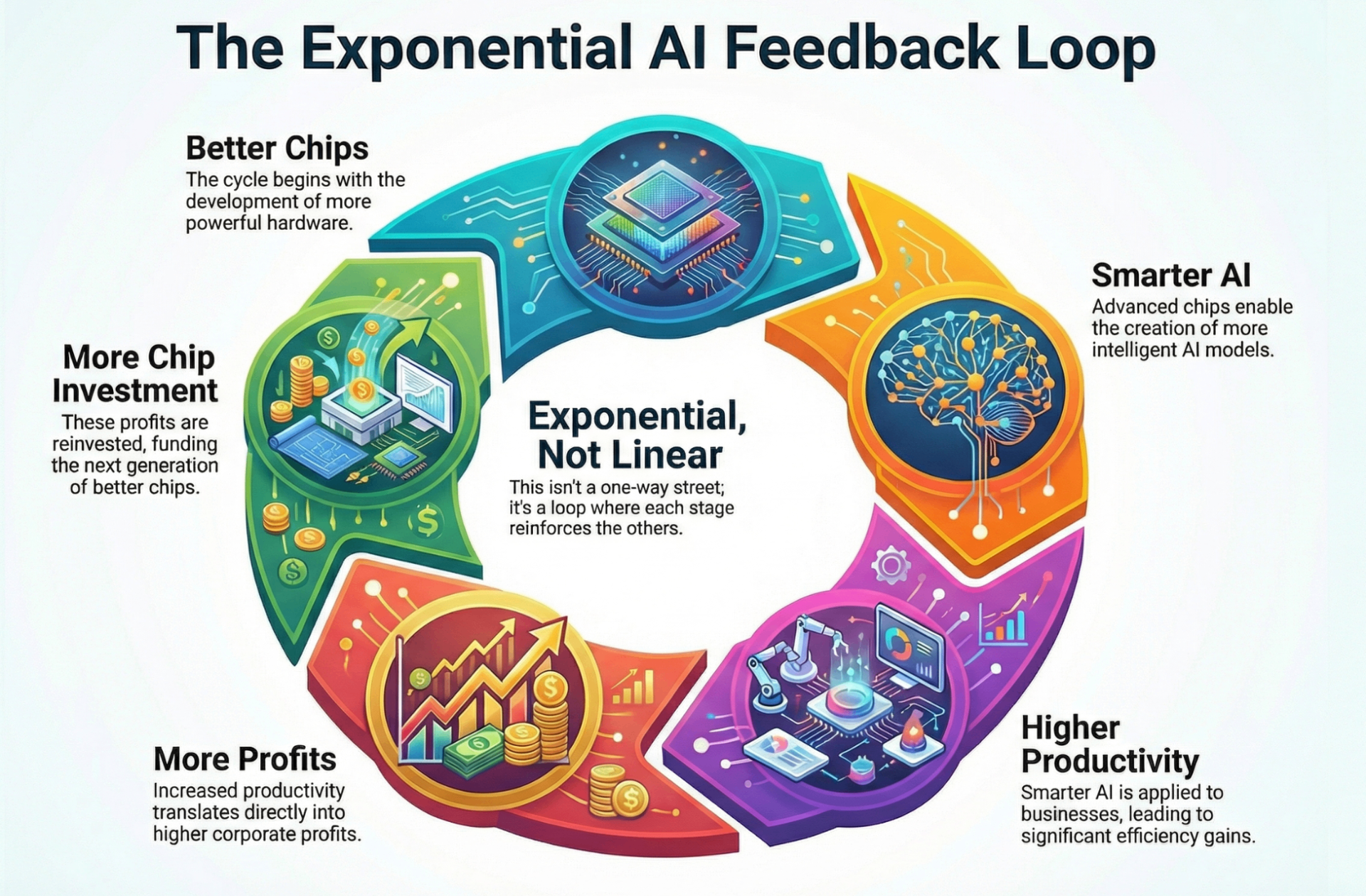
The big story of 2026 isn't one single trend—it's the powerful interplay of several. The seemingly separate headlines about semiconductor shortages, surprising U.S. productivity gains, and the deployment of advanced government software are not isolated events. They are deeply interconnected parts of a virtuous cycle I call the AI Feedback Loop.
Act 1: The Geopolitical Chessboard of Microchips
The foundation of the AI revolution is built on silicon, and its supply chain is both a marvel of global cooperation and a house of cards.
🇺🇸 USA
50%+
Chip Design & 70% Design Tools
🇳🇱 Europe
ASML
EUV Lithography Monopoly
🇹🇼 Taiwan
65%
Advanced Manufacturing
🌏 2026 Forecast
$975B
Global Semi Sales (+26%)
Act 2: The U.S. Productivity Miracle
This explosion in computing power is translating directly into economic output. After a volatile period, U.S. labor productivity has staged a remarkable comeback.
4.9%
Q3 2025 Productivity Growth
54%
U.S. Adults Using Gen AI
37%
Workers Using AI at Work
This widespread adoption has already contributed to a 1.3% aggregate productivity lift since late 2022. We're seeing tangible results in sectors like manufacturing, where output is up while labor hours have fallen. This isn't a statistical blip; it's the tangible economic return on the AI investment.
Act 3: The Digital Detective in Action — Palantir
This AI-driven efficiency is creating demand for new, powerful applications, and Palantir (PLTR) provides a perfect case study. The company recently secured a $300,000 contract with the U.S. Small Business Administration (SBA) for a "Fraud Prevention Pilot and Bootcamp," running through April 4, 2026.
While the contract size is small, its significance is huge. It marks Palantir's expansion from its defense and intelligence roots into civilian government agencies. Palantir's AI platform offers a scalable solution to detect and prevent fraud schemes with 50-90% greater speed than manual methods—demonstrating real-world, high-value demand for sophisticated AI tools.
Part 4: Your 2026 Playbook — Positioning for the Next Decade of Growth
Synthesizing these themes, 2026 is shaping up as AI's true breakout year. The AI Feedback Loop is firing on all cylinders, U.S. productivity is averaging over 3%, and the semiconductor market is roaring towards $1 trillion.
For investors, this isn't a time for speculation but for strategic positioning. The "so what" for your portfolio is to identify the high-quality companies at the very heart of this powerful macro narrative. These are the businesses with the potential to become the long-term compounders of the next decade.
Prime Examples at the Heart of the AI Feedback Loop
🔥 NVIDIA (NVDA) & AMD
The undisputed leaders in AI GPUs and data center compute power that form the bedrock of the revolution.
⚡ Broadcom (AVGO)
A key player in custom silicon (ASICs), essential for optimizing AI workloads for tech giants.
🎯 Palantir (PLTR)
The leader in applying AI to complex data analytics, with a growing footprint in government and commercial sectors.
🏭 TSMC (TSM)
The world's most critical foundry, with a near-monopoly on manufacturing the most advanced chips.
💾 Micron (MU)
A high-conviction play on the coming memory shortage, as AI servers require exponentially more high-bandwidth DRAM.
⛏️ Lam Research & ASML
The "picks and shovels" of the industry—essential manufacturing equipment without which no chips could be made.
Final Thoughts: The Call to Action
The story of 2026 and beyond isn't about chasing hot stocks or reacting to daily headlines. It's about understanding the deep, interconnected narrative of a technological transformation that starts with a microchip in Taiwan and ends with a more productive, efficient, and wealthier global economy.
Success in this market will come from seeing the full picture—the feedback loop—and applying the timeless principles of long-term, quality-focused investing to the companies driving this change.