Own 100 shares? A free covered call scanner that checks earnings
By Stephen Manning, President, Cash Flow University · · 7 min read
You own 100 shares and want a call that ends before earnings. One real KO lookup on CFU's free covered call scanner, the four rules behind it, and what it will not do.
A free tool for anyone who owns 100 shares and wants a call that finishes before the next earnings report.
You own 100 shares. You want them to pay you while you hold them. And you do not want a short call still open when the company reports earnings.
That sounds like one question. It is really four: which expiry, which strike, what price, and does the report land inside the trade or after it.
Open the options chain and you get hundreds of contracts and never a reason. So CFU wrote four rules down for the scanner and built it to apply them. Type any US stock or ETF with listed options and it shows the call that fits CFU's rules, with a check against each rule and the exact order. When nothing fits, it says so and names the reason. Free. No sign-up, no account, no email.
New to covered calls? Start with what a covered call is. Then one real lookup.
One lookup, end to end: KO
This is Coca-Cola at 12:46 PM ET on Tuesday, September 29, intraday. The numbers in this section are from that one screen. Look KO up later and you will see different ones.
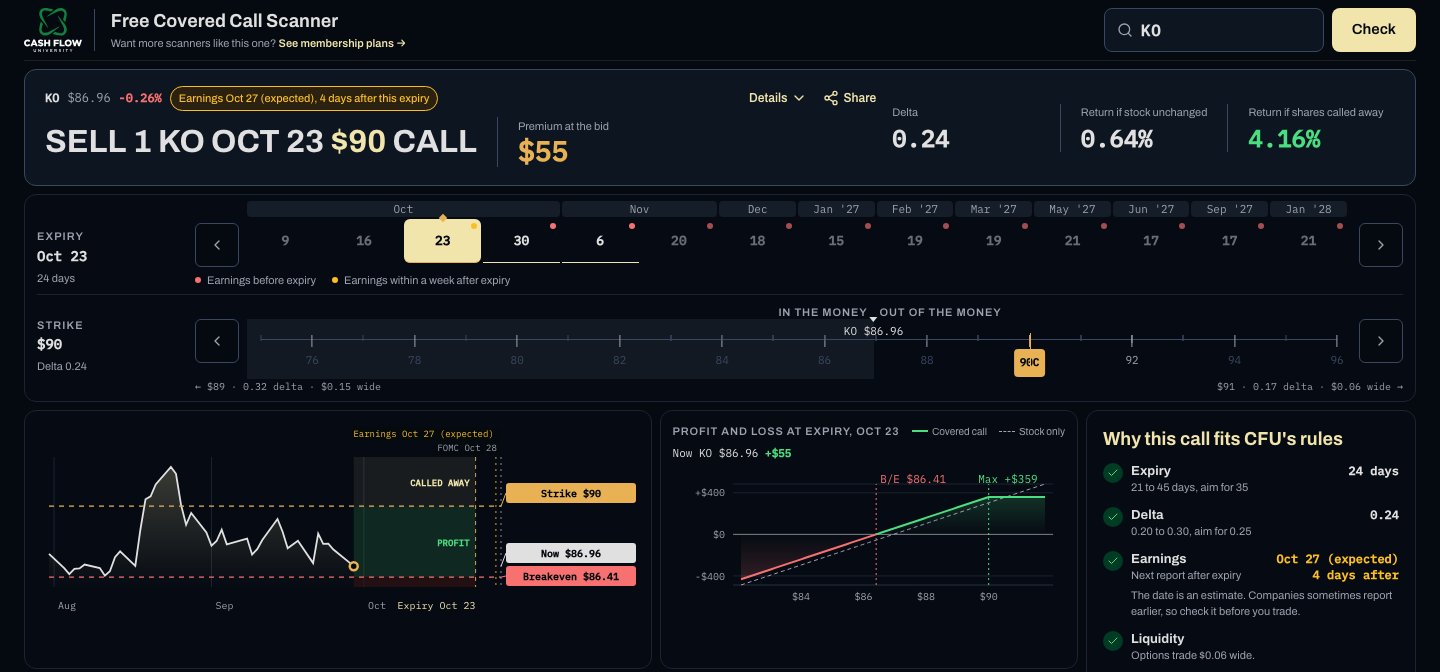
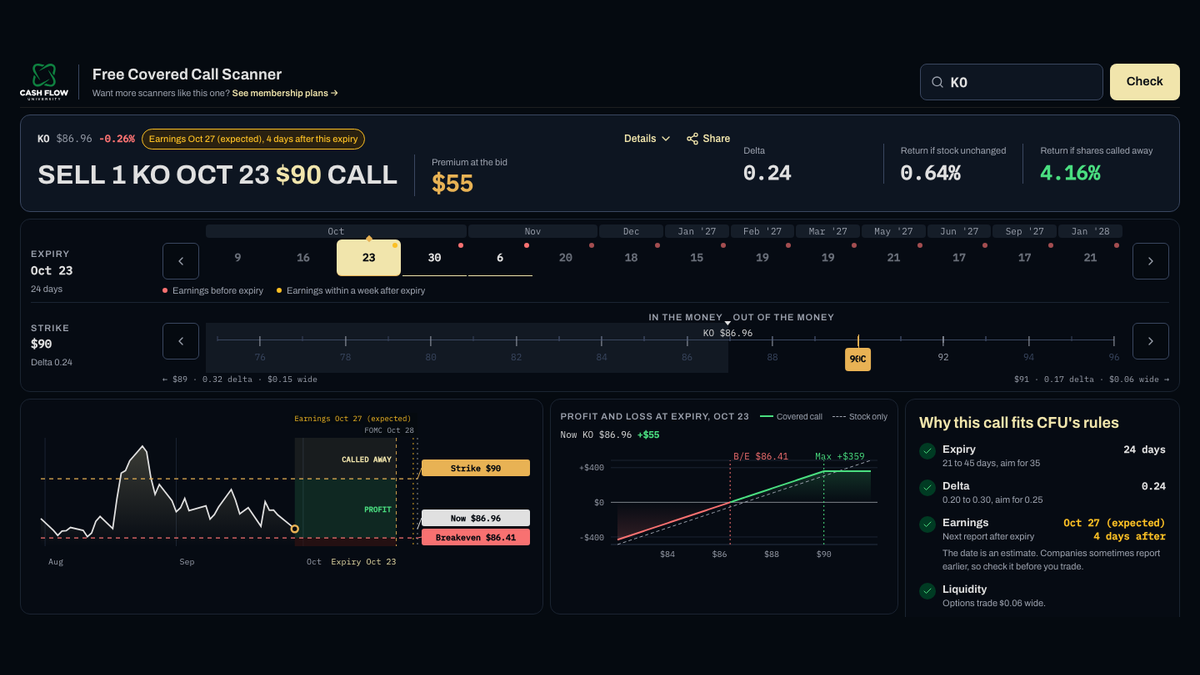
The headline is the call that fits CFU's rules: SELL 1 KO OCT 23 $90 CALL, with KO at $86.96, down 0.26% on the day. One contract covers 100 shares.
The earnings answer, up top. Beside the price sits an amber pill: "Earnings Oct 27 (expected), 4 days after this expiry." The call expires Friday, October 23, and the report is expected the following Tuesday, so the call is done before it. For an owner, that pill is the part I read first.
Amber means the report lands within a week after expiry. Companies sometimes report early, so the Why panel asks you to check the date. On the expiry strip, Oct 30 and later carry red dots because they span the report. That is why the rules skipped Oct 30 and Nov 6, both closer to the 35-day aim.
Premium at the bid. $55 for the contract, $0.55 a share. The bid is the price you could sell at when the quote was taken. A screen quoting the $0.58 mid would have shown $58. Every return, breakeven and profit figure here is priced at the bid.
Two returns, both for 24 days. 0.64% if KO is unchanged on expiry day, against a net cost of $86.41 a share. 4.16% if KO finishes at or above $90 and the shares are called away, the most this trade can make. Neither is stretched into a yearly rate.
Breakeven. $86.41, the stock price less the premium. Below it the position loses $100 for every $1 KO falls. That $55 is the only cushion a covered call gives you.
The charts. The price chart shades CALLED AWAY above $90, PROFIT down to $86.41 and LOSS below, with "Earnings Oct 27 (expected)" and "FOMC Oct 28" marked past the Oct 23 expiry line. The profit and loss chart tops out at +$359 at $90.
The Why panel checks each rule: expiry 24 days, delta 0.24, earnings 4 days after expiry in amber, and "Options trade $0.06 wide." Its Before you sell section asks two questions built from the contract. On KO: am I happy selling at $90? Am I happy holding it below $86.41? I would answer both before I looked at the premium.
The order. Two tickets. For an owner, it is "I own 100 shares".
The ticket starts at the $0.58 midpoint and, if unfilled, steps down a cent every two minutes, never below the $0.55 bid. Copy takes the whole ticket. Not an owner yet? The other ticket is a buy-write, shares and call in one order, with a ceiling instead of a floor.
CFU's rules, and why each one exists
All four are on the page, and the Why panel checks them against any expiry or strike you choose.
| Rule | What CFU's rules look for |
|---|---|
| Expiry | 21 to 45 days out, aim for 35 |
| Strike | Delta between 0.20 and 0.30, as close to 0.25 as a liquid strike allows |
| Liquidity | Bid of $0.05 or more, open interest of 100 or more, spread within 15% of mid or $0.05 a share (30% or $0.10 on closing quotes) |
| Earnings | Expiry ends before the next report |
Expiry. A call with one week left loses value fast and swings hard with the stock. Calls 21 to 45 days out decay more steadily and their strikes sit further from the stock. It is a longer window than the short-dated calls we have written about elsewhere. The standard monthly comes first when it fits. Otherwise the rules take the expiry closest to 35 days, look out to 64 days if nothing in the window works, and never go under 21 days except to finish before earnings.
Strike. Below 0.20 delta the premium gets thin. Above 0.30 the strike sits close to the stock and the shares are more likely to be called away. Near 0.25 leaves room for the stock to rise and still pays a real premium.
Liquidity. An option you can actually sell near the quote. After the close, market makers widen spreads, so closing quotes get the wider allowance. My view: a price you cannot trade near is not a price.
Earnings. A gap down hits your shares and the premium covers a sliver of it. A gap up runs past your strike and your upside stops there. I would rather not carry either for a slightly bigger premium. The check is per expiry, so a report never rules out a whole stock, only the dates that span it.
- Amber: the report falls 1 to 7 days after expiry. Allowed, and flagged. That is KO above.
- Shortened: when the report is close enough that some expiry 21 to 64 days out spans it, and no expiry in that range both finishes before it and has a liquid strike in the band, the rules take the latest liquid expiry that finishes before the report, as short as 7 days. On Sep 28 closing quotes, JPM's report was expected Oct 13, so its trade shortened to the Oct 9 expiry, 10 days out.
- Red: only when no liquid expiry from 7 days out finishes before the report. On Sep 28 closing quotes that was PEP, with a report expected Oct 8. The heading became "Closest call to CFU's rules", and you decide whether to take that risk.
The panel also flags a Fed decision or a declared ex-dividend date before expiry. Owners, note the second: an in-the-money call can be assigned early to capture the dividend. A Fed flag never changes which call fits. More on dates: the date is the trade.
What it will not do
- It has no exit rule. It shows which call fits CFU's rules to sell today, not when to close or roll. Decide how you will manage the position before you sell.
- It does not predict. The chance estimate in Details is drawn from the option's delta, not a forecast.
- It does not protect you from a falling stock. The premium only cushions the first part of a drop.
How owners use it
Before earnings season. Look up each stock you hold and read the expiry strip first: red dots span a report, amber dots have one within a week after, and a gold diamond marks CFU's rule expiry.
You paid more than today's price. Tap Add your cost basis in the owner's card. If the strike sits below your cost, it says in plain dollars how far under cost you would sell if called away.
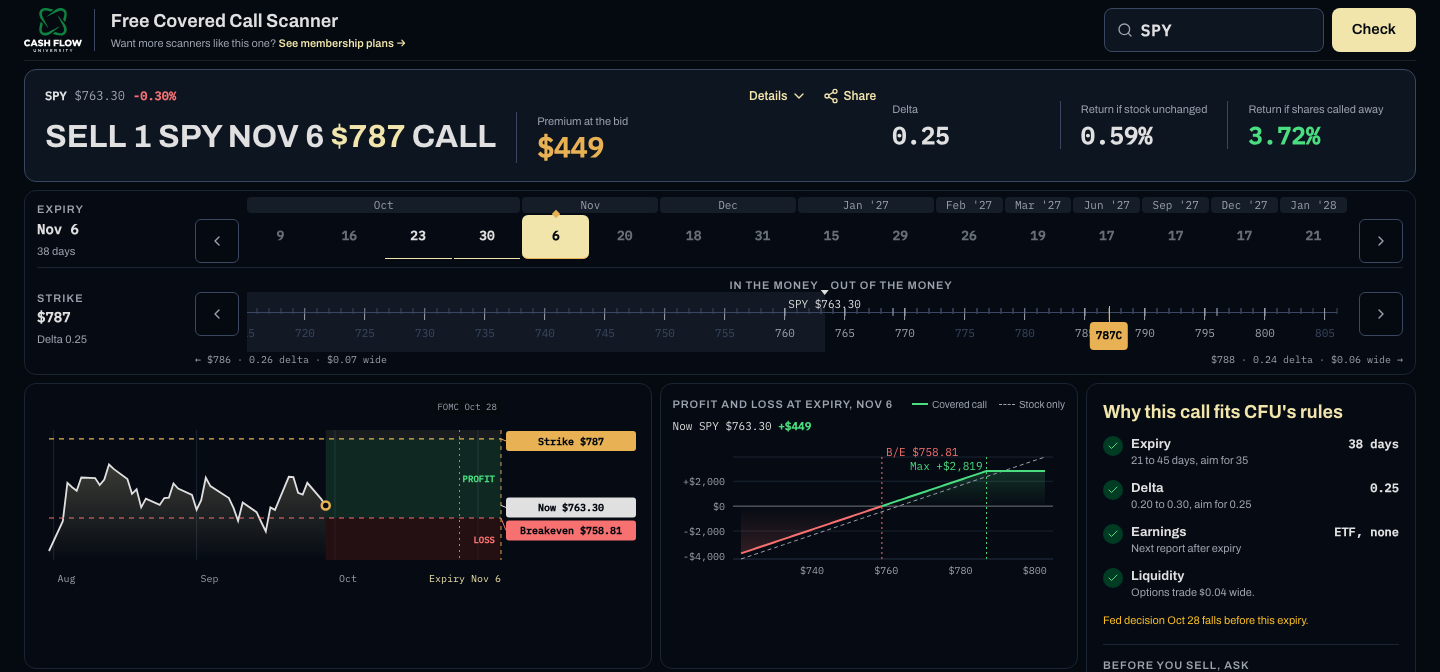
You hold an ETF. ETFs have no earnings of their own, so the Earnings row reads "ETF, none" and the rules run on expiry, delta and liquidity alone. A leveraged single-stock ETF is the exception: it carries its underlying company's report.
A monthly routine. Pick a fixed day each month. The rules prefer the standard monthly expiry when it fits, so a routine tends to land on similar dates. Evening lookups use closing quotes; check again after the 9:30 AM ET open.
Talking it over. Share links the exact contract on screen. A plain link like joincfu.com/covered-call-scanner?t=KO opens CFU's rule call for that day, not the Sep 29 numbers above.
Any US stock or ETF with listed options. The call that fits CFU's rules, with the reasons and the exact order.
OPEN THE SCANNERFree. No sign-up needed.
Educational only. Not financial advice. The scanner shows the call that fits CFU's published rules, not a recommendation to trade any security, and it does not tell you when to close or roll. KO and SPY figures were captured Sep 29, 2026 at 12:46 PM ET, intraday, stock price delayed 15 minutes; JPM and PEP examples use Sep 28, 2026 closing quotes. All change with the market. Options involve risk and are not suitable for all investors. A covered call does not protect you against a drop in the stock beyond the premium you collect, it caps your gain at the strike, and shares can be called away or assigned early.