Stop Buying ULTY and MSTY! The Truth About Covered Call ETF "Income"
By Cash Flow University · · 9 min read
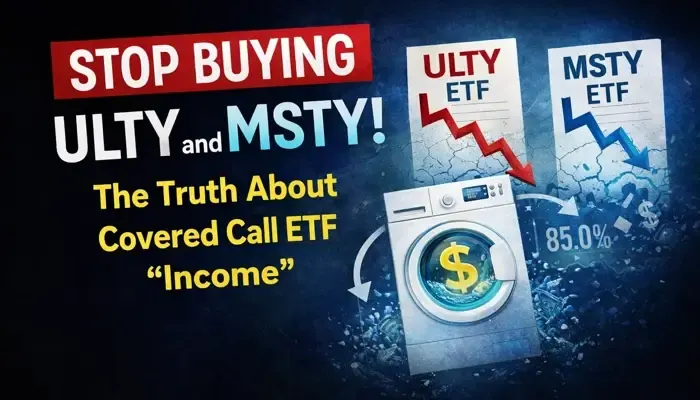
Discover the reality behind covered call ETFs like ULTY and MSTY. Are they really the income solution they claim to be?
I've watched the explosion of high-yield covered call ETFs with growing concern. ULTY promises 70%+ yields. MSTY flashes 50-60% distribution rates. Retirees and income-seekers flock to these funds, seduced by the promise of monthly paychecks that dwarf anything a savings account or bond fund could offer.
Here's the thing. After years of trading options and teaching thousands of members how to generate real income from covered calls, I can tell you these ETFs aren't what they appear to be. The marketing is brilliant. The math? Not so much.
Let me walk you through five truths about these funds that the issuers don't advertise on their flashy fact sheets.
Truth #1: That "Yield" Isn't What You Think It Is
Look at any covered call ETF's marketing materials and you'll see a massive distribution rate plastered front and center. NVDY shows 38.66%. MSTY advertises 60%. ULTY screams 70%+.
Now look at the 30-Day SEC Yield, the standardized measure the SEC requires all funds to report. For NVDY, it's 2.65%. For MSTY and ULTY? Often under 3%.
That's not a typo. There's a 36-percentage-point gap between NVDY's advertised distribution rate and its actual SEC yield.
| ETF | Distribution Rate | 30-Day SEC Yield | Gap |
|---|---|---|---|
| NVDY | 38.66% | 2.65% | 36.01% |
| MSTY | ~60% | ~2% | ~58% |
| ULTY | ~70% | <3% | ~67% |
Why the massive discrepancy? It comes down to a concept called Return of Capital (ROC).
Under U.S. tax law, option premiums don't qualify as "investment income." That category is reserved for dividends and interest. When an ETF pays out more than it earns in qualified income or realized capital gains, the excess gets labeled as ROC.
What is ROC exactly? It's the fund returning a portion of your original investment to you. You gave them $100. They take their fees, maybe make a few bucks on options, and then hand you back $8 of your own money. They call it a "distribution." You think you're earning 8%. You're not.
"What are you paying ULTY for them to give back your money? Seems like a very bad deal."
Now, ROC isn't always bad. Some funds use it strategically for tax-efficient income smoothing. But for these extreme-yield ETFs, ROC becomes a mechanism for returning your own principal, minus fees, when total returns fail to cover the promised distribution.
Truth #2: The "Paycheck" Can Destroy Your Principal
When a fund's total return can't support its distribution, ROC becomes what I call "destructive ROC." The fund has to liquidate its own assets to make payments. This causes permanent erosion of Net Asset Value (NAV).
Think about it. If a fund promises to pay you 60% annually but only generates 10% in returns, that other 50% has to come from somewhere. It comes from selling off the fund's holdings. Every month, the fund gets smaller. Your "yield" stays high because it's calculated on a shrinking base.
This is the total return trap. Investors focus on the payout and ignore the destruction happening to their underlying investment.
The 2025 performance data tells a brutal story:
| Fund | Advertised Yield | 2025 Total Return | Reality Check |
|---|---|---|---|
| ULTY | ~70% | -3.8% | Lost money after reinvesting all distributions |
| MSTY | 50-60% | -42.1% | Catastrophic destruction of capital |
Read that again. An investor in ULTY who reinvested every single distribution would have still lost 3.8% of their investment's value. If they spent those distributions as income? Their principal declined far more.
For MSTY investors, the outcome was catastrophic. A fund advertising 50-60% yields delivered negative 42% total returns. That's not income. That's capital destruction with extra steps.
Truth #3: You Get All the Downside, But Forfeit the Big Wins
The fundamental compromise of any covered call strategy is sacrificing upside potential for immediate income. You cap your gains in exchange for premium.
"Selling covered calls is forfeiting the right tail of your potential return series in exchange for premium (cash) now."
In a flat or slightly down market, covered calls shine. You collect premium while the stock goes nowhere. Great trade.
But in a ripping bull market? The participation gap becomes painful. Your stock rockets up, but your gains are capped at the strike price. You watch everyone else get rich while you collect your modest premium.
The numbers are stark:
| Asset | 2023 Return | 2025 Return |
|---|---|---|
| QQQ (Nasdaq 100) | +55% | +19.8% |
| QYLD (Covered Call ETF) | +22% | +6.2% |
| NVDA Stock | — | +37.8% |
| NVDY (Covered Call ETF) | — | +21.9% |
In 2023, QQQ generated a 55% total return. QYLD? Just 22%. That's a 33-percentage-point participation gap.
In 2025, NVDA gained 37.8%. NVDY returned only 21.9%. You gave up nearly half the upside.
Here's the kicker. While these funds cap your upside, they don't protect your downside. When the market crashes, you own the stock (or its synthetic equivalent). A sharp drop means significant capital losses that option income rarely offsets.
All the downside. Capped upside. That's the trade.
Truth #4: Many of These ETFs Don't Even Hold the Stock
This one surprises most investors. Many newer covered call ETFs, especially the YieldMax products, don't actually own the underlying stock at all.
Instead, they create what's called a "synthetic long stock" position. Here's how it works: they buy a call option and simultaneously sell a put option at the same strike price and expiration. This combination replicates owning the stock but requires far less capital upfront.
The money they save? It gets parked in short-term Treasury securities as collateral for the derivative positions.
This capital-efficient structure sounds clever, and in some ways it is. But it introduces risks that don't exist in traditional ETFs:
Counterparty risk: Your "position" exists as a contract with another party. If that party fails, you have a problem.
Liquidity risk: The options contracts themselves may not trade as freely as the underlying stock, especially during market stress.
Complexity risk: Most investors don't understand what they actually own. They think they hold NVIDIA. They hold a complex derivative structure.
This isn't necessarily a dealbreaker, but you should know what you're buying. A "covered call ETF" that doesn't own shares operates very differently from one that does.
Truth #5: Volatility Becomes a Hidden Drag on Your Investment
Single-stock covered call ETFs face a mathematical headwind that's invisible to most investors: volatility drag, also called variance drain.
Here's the concept. An investment's long-term performance depends on its compounded (geometric) return, not its simple average return. When volatility is present, the compounded return is always lower than the average return. Higher volatility means greater drag.
Simple example: You have $100. Year one, you gain 50% ($150). Year two, you lose 33% ($100). Your average return? 8.5% per year. Your actual return? Zero. That's volatility drag.
This effect is especially damaging for funds built on volatile single stocks like MicroStrategy or NVIDIA. MSTR's daily moves can be wild. NVDA swings 5%+ on earnings. Every swing, up or down, compounds the drag.
For these funds to simply maintain a stable Net Asset Value, the underlying asset must generate immense returns. They face a triple headwind:
- Volatility drag from the underlying stock's wild price swings
- High expense ratios (typically 0.99%) eating into returns
- Capped upside from the covered calls limiting their best days
The stock has to not just perform well. It has to massively outperform just to overcome these structural handicaps. When it doesn't, NAV erodes, and your "70% yield" becomes a -42% total return.
The CFU Perspective: Covered Calls Done Right
I'm not anti-covered call. Far from it. Covered calls are one of the best income strategies available to retail investors. I teach them extensively.
But there's a massive difference between running your own covered call strategy and outsourcing it to an ETF.
When you sell covered calls yourself:
- You keep 100% of the premium. No 0.99% expense ratio. No fund manager fees.
- You choose your strikes. Feeling bullish? Sell further out of the money. Concerned about a pullback? Sell closer to the money for more protection.
- You control the timing. Don't want to cap your upside before earnings? Don't sell calls. Simple.
- You decide on assignment. If your shares get called away, you choose whether to buy back in or move on.
ETFs make these decisions for you, at scale, with a one-size-fits-all approach. They can't adapt to your outlook or your tax situation. They just mechanically sell calls and collect fees.
The premium you would have kept goes to the fund company. The flexibility you would have enjoyed disappears. The strategy that works brilliantly when customized becomes mediocre when commoditized.
The Bottom Line
High-yield covered call ETFs are financial engineering products. They're designed to generate eye-catching distribution rates that attract assets. The 70% yield on the marketing materials drives inflows. The -42% total return? That's buried in the fine print.
I'm not saying these funds have zero use cases. In a flat, sideways market, they might outperform buy-and-hold. For someone who absolutely needs monthly income and won't touch principal, maybe the psychological benefit of regular payments has value.
But for building wealth? For long-term compounding? For capturing the full upside of a bull market? These funds are structurally designed to underperform.
The irony is thick. The strategy these ETFs are based on, selling covered calls, actually works well. It just works better when you do it yourself.
You get the full premium. You control the strikes. You keep the flexibility. You avoid the expense ratio.
That's why we teach covered calls at Cash Flow University. Not as a passive ETF investment, but as an active skill that puts you in control of your income generation. The learning curve is modest. The payoff is significant.
Before you chase that 70% yield, ask yourself: do you want the illusion of income, or the real thing?