Covered Calls: Turning Stock Ownership into Cash Flow
By Cash Flow University · · 6 min read

Discover how covered calls can transform your stock portfolio into a steady income stream.
Introduction
Welcome to the world of covered calls, where savvy investors turn stock ownership into a steady cashflow stream. Covered call writing is a strategic way to generate income, manage risk, and potentially enhance portfolio returns. Whether you're a seasoned investor or just diving into options trading, understanding the nuances of covered calls can be incredibly beneficial.
As outlined in the Cash Flow University (CFU) philosophy, this strategy positions you as the "Seller" (the House) rather than the "Buyer" (the Gambler). By selling calls, you collect upfront premiums while the buyer must be right on both direction and timing, fighting against time decay. This zero-sum game favors sellers, who profit if the stock rises moderately, stays flat, or drops slightly.
Why Covered Calls?
Covered calls are popular among investors seeking income while maintaining a grip on the stocks they own. By holding 100 shares of a stock, you can sell a call option on that stock, earning a premium—much like renting out your shares. While it caps the maximum upside, it offers a buffer against market downturns and generates steady income especially when markets are volatile.
The CFU approach emphasizes being the seller to capture extrinsic value (time and volatility) as it decays to zero at expiration. This contrasts with buyers, who face constant decay. Historical data shows covered calls can reduce volatility by 20-30% compared to buy-and-hold, making them ideal for income-focused portfolios in neutral or sideways markets.
✅ Pros
- ✓ Generates immediate premium income
- ✓ Relatively low risk (covered by owned shares)
- ✓ Hedges risk with downside buffer
- ✓ Easy to set up and repeat
- ✓ Works on dividend and non-dividend stocks
⚠️ Cons
- ✗ Caps upside potential on stock gains
- ✗ Doesn't fully protect against major losses
- ✗ Locks you into holding during declines
- ✗ Transaction costs can erode returns
- ✗ Underperforms in strong bull markets
The Basics of Selling Covered Calls
Definition and Functionality
A covered call involves selling call options on stocks you already own. This strategy is called "covered" because the seller owns the underlying stocks, providing protection against unlimited loss. You need to own 100 shares per call contract sold to back the position—no margin calls or unlimited risk, as max loss is capped at the stock's value minus premium.
The trade-off involves receiving an upfront premium in exchange for capping upside potential if the stock price exceeds the strike price.
Options Pricing Breakdown
- Intrinsic Value: The "real value" based on the current stock price relative to the strike.
- Extrinsic Value: Time (Theta) and volatility (Vega)—the key profit source for sellers, decaying to zero at expiration.
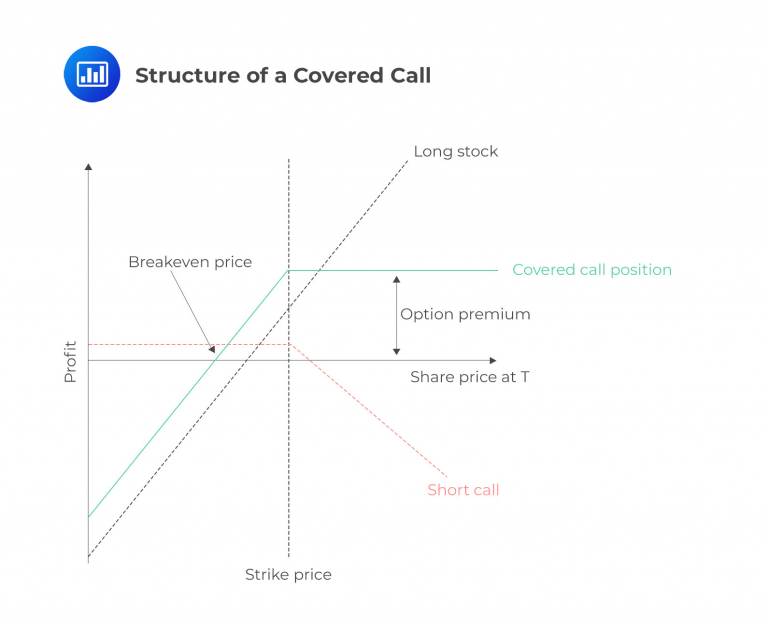
Profit and Loss Structure
- The profit zone includes both premium income and any stock appreciation up to the strike price (yellow/gold area in diagram).
- Downside risk includes potential losses in the stock value, offset by the premium received (red loss zone).
- Breakeven: Stock price minus premium received.
- Compared to long stock only (unlimited upside), covered calls trade that potential for defined income.
Timing is Everything
Optimal Selling Conditions
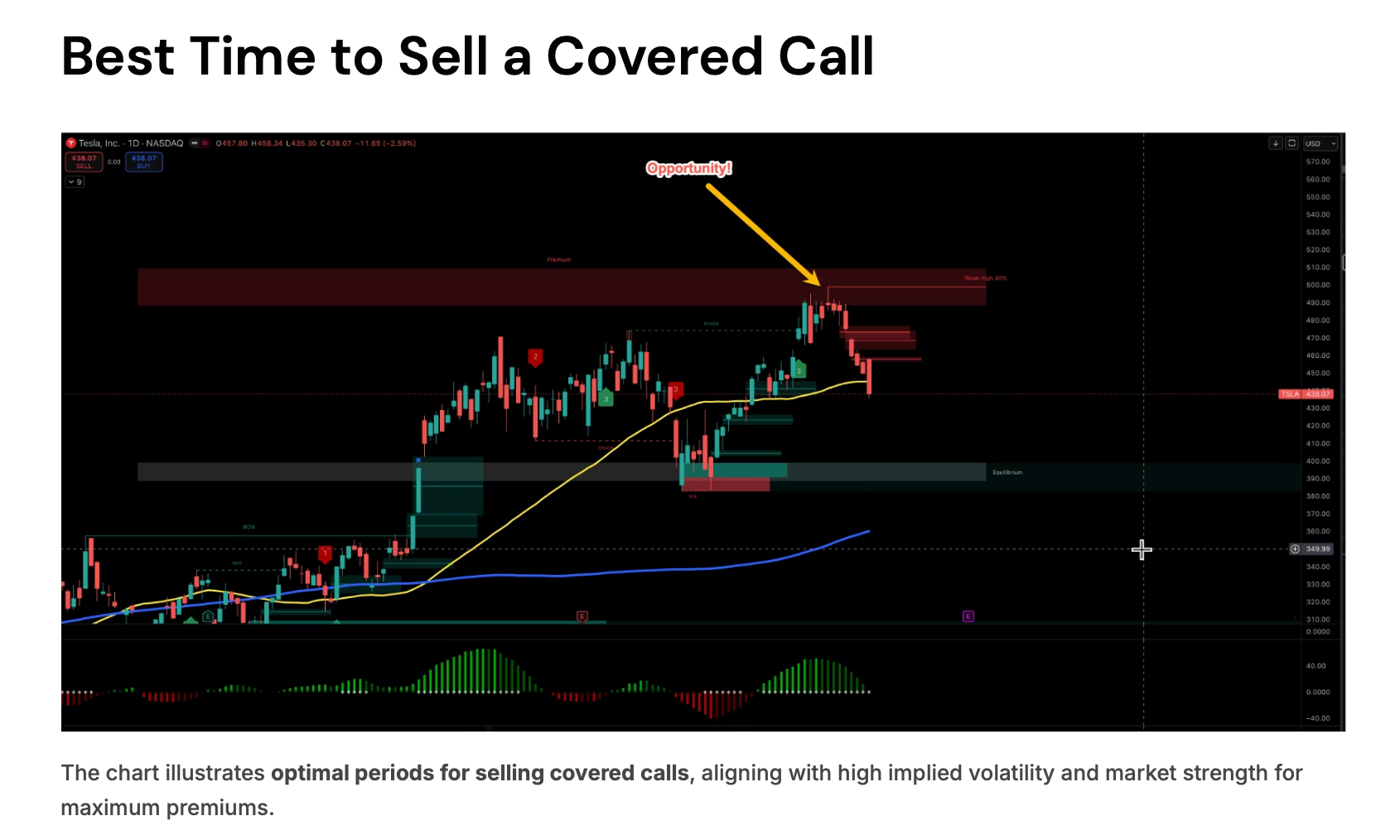
Selling into strength is crucial. Look to offload calls when shares are gaining value or volatility is high. It's crucial to wait for these peaks, as it maximizes the premium you can receive. CFU rules target elevated Implied Volatility (IV) for higher payouts, mean reversion at extremes, and post-rally entries.
📋 CFU Entry Checklist
- Elevated IV: Maximize premium collection
- 20-30 Delta: High probability of expiring worthless (70-80% OTM)
- 10-20 Days to Expiration: Sweet spot for fastest theta decay
- Strike above cost basis: Always protect your entry price
Best Practices
- Sell on stocks with long-term conviction but perceived overvaluation or lower volatility than implied.
- Best during market overvaluation or for slow-growth stocks to combine dividends, premiums, and modest growth.
- Use OTM calls to balance income and retention probability.
Case Study: Tesla (TSLA)
Take Tesla (TSLA) for example. By charting various highs and lows, the perfect timing to sell covered calls would be during market highs followed by a decline, where volatility premiums are more attractive.
CFU TSLA Example Trade
- Own 100 shares at $438
- Sell 30 Delta call, 15 DTE, Strike $465, Premium $1,250
- Net Cost Basis: $425.50
Outcomes:
- Stagnation (TSLA at $440): Keep premium + shares
- Rally (TSLA at $480): Shares called at $465, Total Profit $3,950
Possible Outcomes Summary
Three of four scenarios are profitable per CFU methodology.
Risk Management and Profit Taking
Risks of Covered Calls
- Capped profit potential if the stock soars past the strike price
- Stock value decline may outweigh the premium received
- Never hold through earnings – gap-ups can cause assignment at unfavorable prices
Historical data shows covered calls can underperform in strong bull markets. A strategy involves actively managing positions, not waiting for absolute profits, thus avoiding tail risks.
When to Take Profits
💡 The 85% Rule
Once a position hits 85% of the maximum potential profit, consider closing (buy to close). This avoids unforeseen market shifts, preserving gains and freeing capital for new opportunities. Treat each trade as an "income harvest" to reduce cost basis.
Rolling Options: A Strategic Tool
Rolling, or shifting your option to a later time or different strike, can be useful but requires experience. While some avoid it, others use it to extend opportunities, especially if they maintain their bullish stance on the stock.
Key Takeaways
🎯 Key Takeaways
- Be the Seller (the House) – collect premiums while time decay works in your favor
- Target 20-30 Delta, 10-20 DTE, elevated IV for optimal entries
- Three of four possible outcomes are profitable with covered calls
- Close at 85% profit to lock in gains and free capital
- Never hold through earnings to avoid gap risk
- Discipline and rules beat "gut feelings" for consistent results
📚 Download the Free Covered Calls Guide
Get our comprehensive PDF guide with detailed examples, checklists, and strategies for mastering covered calls.
Download Free PDF Guide →Conclusion
Covered calls are a powerful tool in a trader's arsenal, providing both income and strategic portfolio management. Discipline wins: Follow rules like Delta, DTE, and IV for consistent results over "gut" feelings. While offering 12-24% potential annual returns with lower volatility, they may lag buy-and-hold in strong bulls.
Whether you are a seasoned trader or new to the world of options, executing covered calls can be an excellent way to enhance your financial strategy. Join the CFU community to engage with like-minded investors, access trade alerts, and expand your knowledge in options trading.