Options Assignment Explained: What Happens When Your Option Gets Assigned
By Stephen Manning · @StephenCFU on X · · 9 min read
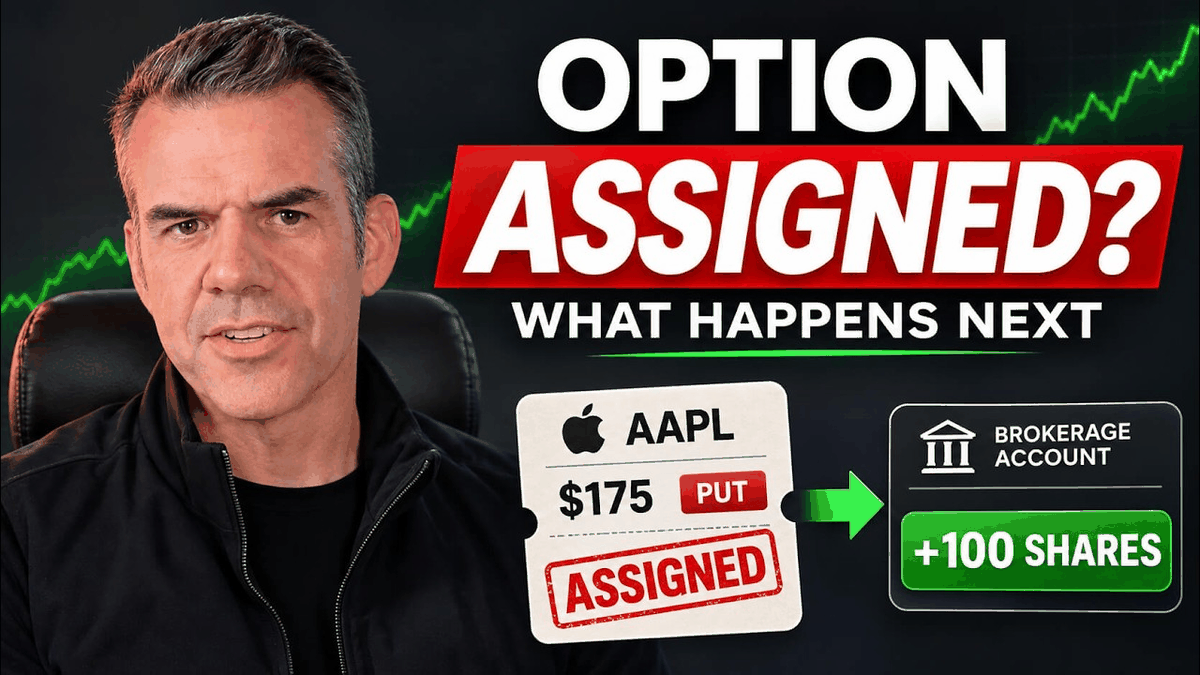
Assignment is what happens to an option seller when the buyer uses it. See what lands in your account for sold puts, covered calls and calls with no shares.
Assignment is what happens to the seller of an option when the buyer uses it. It can add 100 shares to your account or take 100 shares out of it, and it can come before the option expires.
You sold a put. The next morning you open your account, and the put is gone. In its place are 100 shares, and a lot less cash. Selling an option means the buyer pays you a price, and you take on a promise you may have to keep.
I'm Stephen, from Cash Flow University. This is education, and none of it is advice. Every price in this post is a model example, made up to show the mechanics.
What are exercise and assignment?
An option is a contract on 100 shares. Its price is called the premium. The buyer pays it out, and the seller takes it in.
Exercise is the buyer using the right the contract gives. Assignment is the other side of the same event: the seller is told to carry out the contract.
| Term | What it means |
|---|---|
| Strike | The fixed price in the contract |
| Expiration | The last day the contract is good for |
| Call | The right to buy 100 shares at the strike |
| Put | The right to sell 100 shares at the strike |
An option is in the money when using it beats the market. For a put, the stock is below the strike. For a call, it's above.
So when a put is assigned, the seller has to buy 100 shares at the strike. When a call is assigned, the seller has to sell them at the strike.
At expiration, an option that finishes in the money is usually exercised without anyone asking, unless the holder tells the broker not to. Each broker sets its own rules for that. If it finishes out of the money, it normally expires, and the seller keeps the premium.
Who gets assigned?
The clearing house behind listed options, the ones traded on an exchange, chooses a member firm at random. That firm, which may be your broker or the firm that clears for it, chooses an account by a method it publishes.
You usually find out the next morning, on your broker's schedule.
What happens when a sold put is assigned?
The seller of the put has to buy 100 shares at the strike. The cash comes out of the account, and the premium taken in earlier stays.
You sell a put with a $40 strike. The stock is at $41, with 30 days to expiration. The model prices that put at $1.20 a share. A contract is 100 shares, so you take in $120.
Now say the stock ends at $37 at expiration. The put is in the money, and it's assigned.
| Step | Amount |
|---|---|
| You pay out for 100 shares at the $40 strike | $4,000 |
| The shares are worth, with the stock at $37 | $3,700 |
| Down on the shares | $300 |
| Premium you took in | $120 |
| Down after the premium | $180 |
The premium stays with you, so the $300 down on the shares becomes $180.
What is the break-even on a sold put?
Break-even is where you have no gain and no loss. For a sold put, it's the strike minus the premium: $40 minus $1.20 is $38.80 a share.
Below $38.80, you're down on the position, and the loss is on paper until you sell the shares. It moves with the stock. If the stock keeps falling, so does the loss. At zero, you'd be down $3,880.
If the cash isn't there, what happens depends on your broker and account type. A broker can sell other positions to raise it, even without phoning you first.
What happens when a covered call is assigned?
A covered call means you own 100 shares and sell a call on them. If the call is assigned, your shares are sold at the strike, and you keep the premium.
You bought the shares at $100 each. You sell a call with a strike of $105, for $2 a share. That's $200 you take in.
If the stock ends above $105, the call is normally assigned, and your shares are sold at that strike.
| Step | Amount |
|---|---|
| Shares sold at the $105 strike | $10,500 |
| Shares cost, at $100 each | $10,000 |
| Stock gain | $500 |
| Premium you took in | $200 |
| The most this can make | $700 |
At $115, you still make $700. The $1,000 of gain above $105 goes to the call buyer. For many covered call sellers, that sale was the plan.
Selling the call doesn't remove the downside of owning the shares. If the stock falls, the premium only softens the loss. At zero, the shares lose $10,000, and the premium covers $200 of it.
What happens when a call sold with no shares is assigned?
The seller has to deliver 100 shares the seller doesn't own. Depending on the broker, the account ends up owing those shares, or the broker buys them for you. This is also called a naked call.
Take a $105 call sold for $200, with no shares owned. Say the stock is at $120 at expiration. You deliver the shares at $105, but buying them costs $120. That's $1,500 down, and the $200 you took in cuts it to $1,300. The loss has no ceiling.
At $140, you're down $3,500, or $3,300 after the premium.
Every dollar the stock rises costs another $100 on the contract. A stock has no top price, so this loss has no ceiling. A seller's loss can be far bigger than the money collected.
Can an option be assigned early?
Yes. Standard options on US stocks and ETFs, funds that trade like stocks, are American style. The buyer can exercise on any day the market is open, so a seller can be assigned early.
Nobody knows in advance when. A seller can end the position first by buying the option back.
Time value is the part of an option's price above what it would be worth if used today. Using the option gives that part up. Early assignment is more likely when an option is deep in the money, far past the strike, with little time value left to give up.
How can a dividend cause early assignment?
A dividend is cash a company pays its shareholders. The ex-dividend date is the first day a stock trades without its next dividend.
To get the dividend, a call holder has to own the shares before that day, which means exercising the day before. So the seller of that call can be assigned the day before.
The stock is at $100, and a $90 strike call is priced at $10.20. Of that, $10 is its value if used today, and $0.20 is time value. Tomorrow it goes ex-dividend, with a $0.60 dividend. In the model, the stock drops that much and nothing else changes. That puts it at $99.40.
| Path | Per share |
|---|---|
| Hold the call | $9.60 |
| Exercise the day before | $10.00 |
Held through that day, the call is worth $9.60, with no dividend. That's $9.40 if used, with the stock at $99.40, plus $0.20 time value. Exercised the day before, the holder ends up with $10.00 a share, counting the dividend. That's the $99.40 stock, plus the $0.60 dividend, minus the $90 strike. Compared with holding, that's $0.40 a share ahead, or $40 on 100 shares.
What are European style options?
European style options are exercised only at expiration. SPX options, on the S and P 500 index, are European style, and they settle in cash, so no shares change hands.
If one finishes in the money, the seller pays the gap between where the index finishes and the strike, in cash, which can be far more than the premium.
What happens when one put in a spread is assigned?
A put credit spread is two puts with the same expiration. The money you take in up front is called the credit. You sell the higher strike, and buy the lower one as protection.
If the put you sold is assigned, you have to buy 100 shares at its strike. The put you bought is still in the account, and it lets you sell the shares at its own strike.
Use the same model stock at $41. You sell the put with the $40 strike (the $40 put) and buy the $35 put. You take in about $1.20 on the $40 put, and pay out about $0.10 on the $35 put. So the credit is about $1.10 a share in this model, about $110.
At expiration, below $35, the put you bought gains a dollar for each dollar the $40 put loses. So the worst case is the $5 gap between the strikes, minus about $1.10 a share, the credit you keep. Times 100 shares, that's about $390.
Now say the stock drops hard, and the $40 put is assigned early. You pay out $4,000 for 100 shares at the $40 strike.
There are two ways out. One is exercising the $35 put, which sells the shares at $35. That is $5 below the $40 you paid, the gap the worst case already counts. The other is selling the shares and the put in the market. Before costs, both stay within that worst case.
Until you act, the account needs cash for the shares, or money borrowed from the broker, called margin.
Recap: what to remember
The risk, in plain words
A seller's loss can be larger than the premium collected.
Free tools and the video
Educational content. Not financial advice. Options carry risk of loss, and selling options can lose more than the premium collected. How and when assignment is handled varies by broker.