How Robotaxis Are Transforming Transportation: The Future of Autonomous Mobility
By Cash Flow University · · 6 min read
A 30-mile Uber ride costs $75. A robotaxi does it for $9. I break down why this isn't just a price cut, it's a structural replacement of transportation as we know it, and what it means for investors, commuters, and entire industries.
The Impending Disruption: How robotaxis Are Set to Transform Our World
I've been watching the autonomous vehicle space for years now. And I'll be honest, for the longest time it felt like one of those "always five years away" technologies. But something shifted recently. The economics changed. The tech matured. And now I'm convinced we're standing at the edge of one of the most significant disruptions in modern history.
This isn't about cool gadgets or futuristic fantasies. It's about cold, hard math. And the math says robotaxis are about to obliterate entire business models.
Let me walk you through why.
The Current Costs of Transportation
Let's start with something everyone can relate to. You need to get from point A to point B. It's 30 miles. What are your options?
If you fire up Uber in Austin right now, that 30-mile ride is going to run you about $75. That's not surge pricing. That's just a normal Tuesday afternoon. Seventy-five dollars. For a 30-minute car ride.
Now let's say you own a Tesla. That same trip costs roughly $17. About a dollar for electricity and around $16 when you factor in depreciation and insurance. Already a massive difference.
But here's where it gets really interesting.
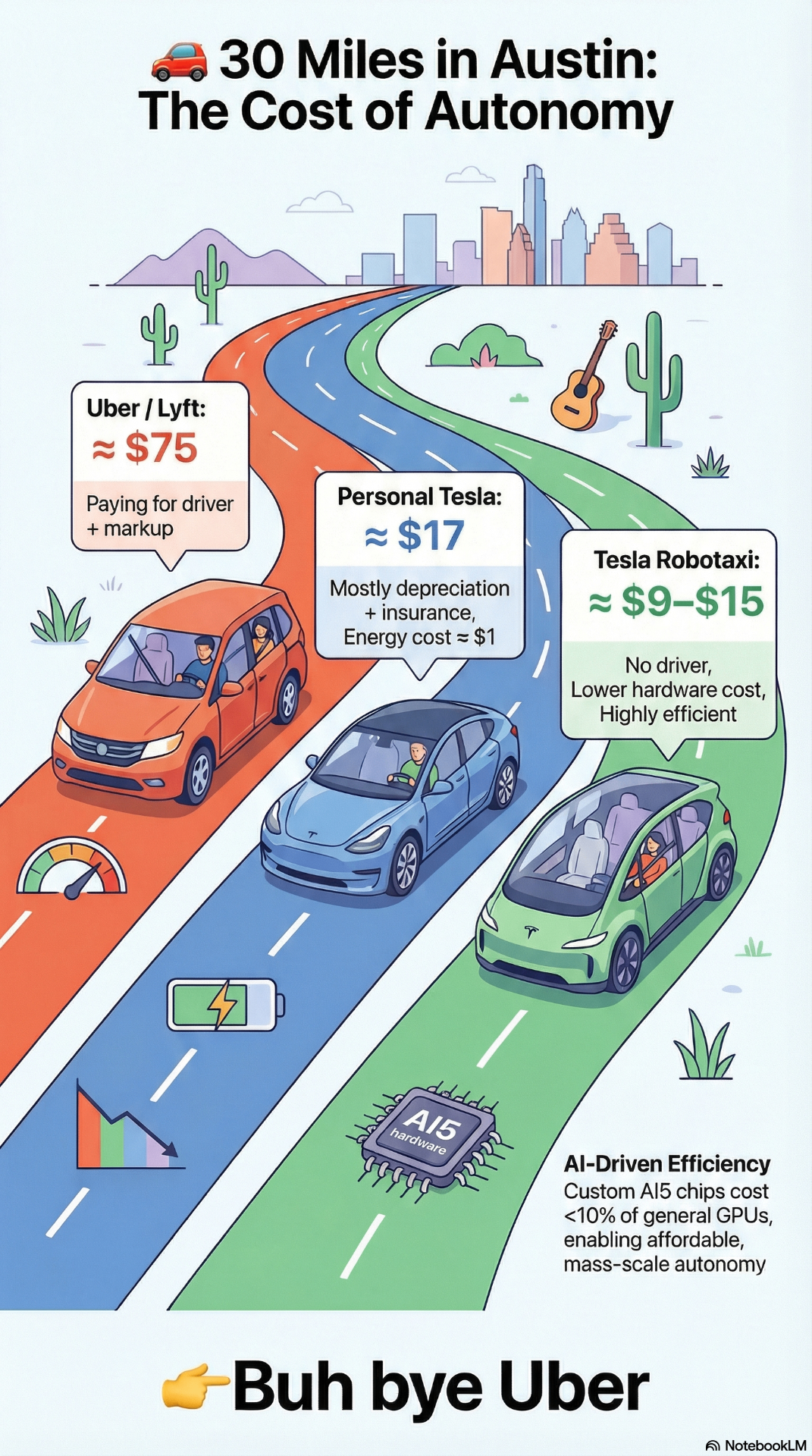
Cost breakdown for a 30-mile ride: The robotaxi advantage is overwhelming
Enter the Robotaxi Revolution
Now remove the driver from the equation entirely. When Tesla, or any comparable autonomous service, operates your ride, that same 30-mile trip drops to somewhere between $9 and $15.
Read that again. Nine to fifteen dollars.
That's not a marginal improvement. That's an 80-88% cost reduction compared to Uber. And it's not some wild projection based on fantasy assumptions. The math is straightforward: eliminate the biggest cost center (the human driver), optimize routing with purpose-built chips, and let the vehicle operate nearly 24/7 instead of sitting in a parking lot for 95% of its life.
The key insight: Custom-designed chips enable autonomous operations at a fraction of traditional computing costs. This isn't just software eating the world. It's purpose-built silicon making the impossible economical.
This Isn't an Upgrade. It's a Structural Replacement.
I want to be really clear about something. What we're looking at here isn't a better version of Uber. It's the end of Uber's current business model as we know it.
Think about it this way. When Netflix launched streaming, it didn't just make Blockbuster slightly less convenient. It made the entire concept of driving to a store, picking up a physical disc, and returning it feel absurd. That's what robotaxis are about to do to ride-sharing.
Why would anyone pay $75 for a ride when the same trip costs $9? The answer is they won't. Not when the alternative is just as convenient, arguably safer (no distracted human driver), and available 24/7.
And it's not just ride-sharing companies that should be paying attention. Think about all the businesses built on top of human-driven transportation:
- Taxi companies still hanging on in major cities
- Car dealerships selling personal vehicles to people who could just summon a robotaxi
- Insurance companies writing policies for human error that autonomous systems largely eliminate
- Parking garages and lots in urban centers, because robotaxis don't park, they keep moving
- Auto body shops that depend on accident repairs
Every single one of these industries is exposed. Some will adapt. Many won't.
The Depreciating Asset in Your Driveway
Here's a number that always stops people in their tracks. The average American spends between $10,000 and $12,000 per year on car ownership. That includes payments, insurance, gas, maintenance, and depreciation. And their car sits unused about 95% of the time.
That's insane when you think about it. You're paying over ten grand a year for something that does nothing for 23 out of 24 hours.
The ownership question: If a robotaxi can take you anywhere you need to go for a fraction of ownership costs, with no parking hassles, no maintenance headaches, and no insurance paperwork, at what point does owning a car stop making sense?
For a lot of people, that tipping point is coming fast. Maybe not in rural areas where you need a truck for your property. But in cities and suburbs where most Americans live? The math is going to be impossible to ignore.
The Broader Economic Ripple Effects
The disruption doesn't stop at transportation. Once you have a fleet of autonomous vehicles running 24/7 at minimal cost, the second-order effects are enormous.
Real estate changes. If you don't need a car, you don't need a garage. You don't need to live near a train station. Suburban development patterns shift. Urban parking lots become developable land.
Logistics gets disrupted. If autonomous vehicles can move people cheaply, they can move packages even cheaper. Same-day delivery becomes same-hour delivery. Local businesses can compete with Amazon on convenience.
Healthcare access improves. Missed medical appointments due to lack of transportation are a massive problem, especially for elderly and lower-income populations. Robotaxis eliminate that barrier entirely.
Employment patterns shift. The "commute radius" expands when your commute is productive time instead of stressful driving. You can work, sleep, or prep for meetings while your robotaxi handles the road.
What This Means for Investors
I look at this through a lens of opportunity. Every major disruption creates winners and losers. The companies building the autonomous infrastructure, the chip makers, the fleet operators, the mapping and sensor companies, they're positioned on the right side of this curve.
Meanwhile, companies that depend on human-driven transportation as a core business model need to pivot or face extinction. This isn't hyperbole. It's what happens every time a technology makes a fundamental cost input collapse.
Look at what happened to film photography when digital cameras arrived. Or what happened to travel agencies when the internet made booking flights trivial. The incumbents who didn't adapt disappeared.
Investment angle: The robotaxi revolution isn't just about one company or one stock. It's about understanding which industries will be compressed and which will expand. Position yourself on the expanding side.
The Timeline Is Closer Than You Think
Waymo is already operating commercial robotaxi services in Phoenix, San Francisco, and Los Angeles. Tesla is pushing hard on its FSD platform. Chinese companies like Baidu are running autonomous fleets in multiple cities. This isn't some distant future scenario. It's happening right now, today, in real cities with real passengers.
The question isn't whether robotaxis will disrupt transportation. That's already settled. The question is how fast it scales, and whether you're positioned for it.
Embracing the Change
I get it. Disruption is uncomfortable. The idea that millions of driving jobs could be displaced is genuinely concerning, and I don't want to minimize that. But the flip side is equally compelling: cheaper transportation for everyone, fewer traffic deaths, less pollution, more productive commute time, and the liberation from one of the biggest financial drains in most families' budgets.
The cost curve doesn't lie. When you can move 30 miles for less than the price of a fast-food meal, everything about how we live, work, and invest changes.
We're not just passengers in this transition. We're pioneers. And the smartest move you can make right now is to understand the economics, position yourself accordingly, and embrace the future that's already arriving.
Want to Position Yourself for Market Disruptions?
I break down market-moving trends like this every week, along with actionable trade setups. Join the community.
See Our Plans →