Options Strategies for Small Accounts in 2026
By Stephen Manning · @StephenCFU on X · · 17 min read
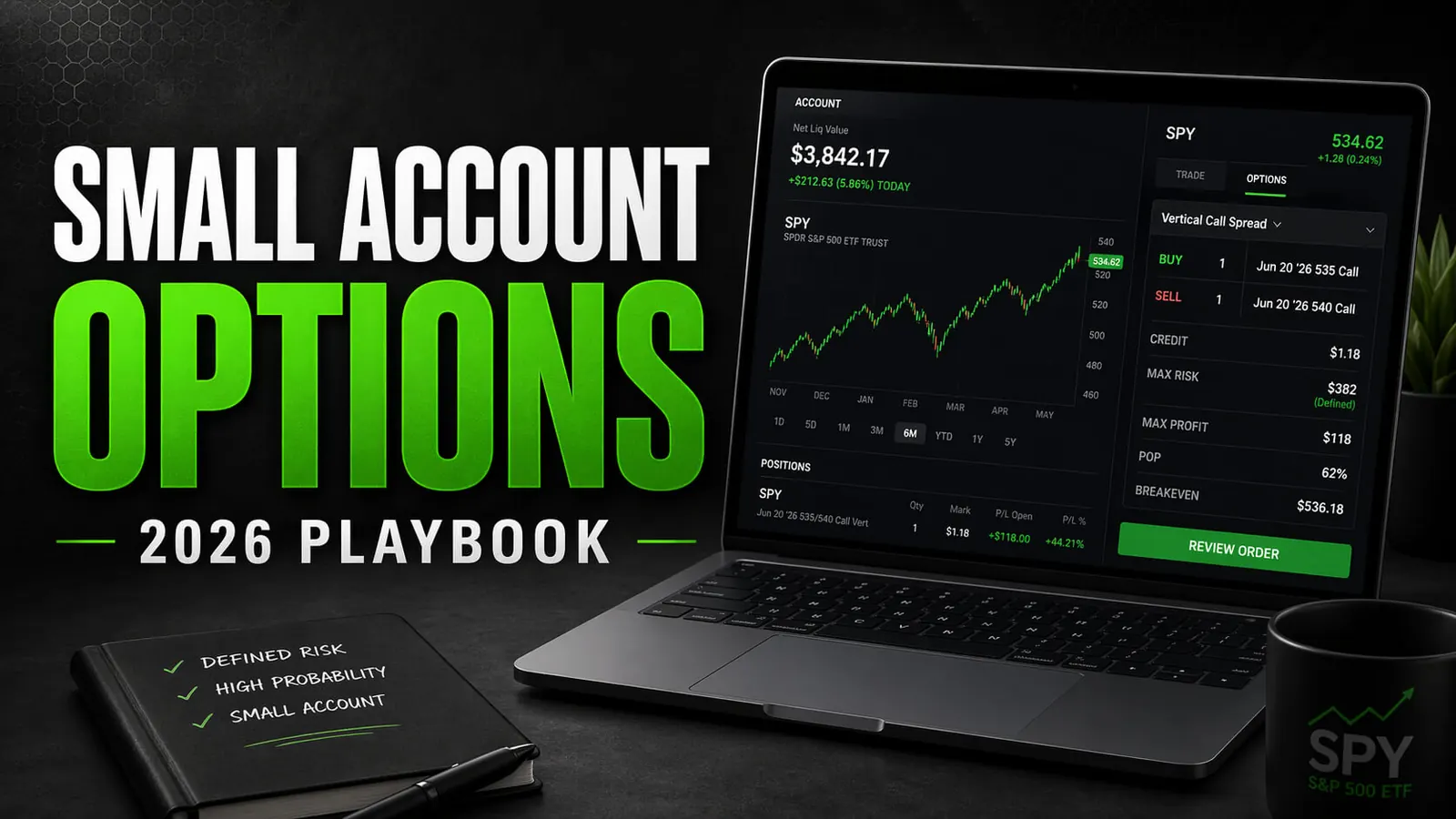
Options strategies for small accounts in 2026: credit spreads from $500, then cash-secured puts and covered calls as the account grows, with sizing and exits.
Last updated: October 1, 2026
The options strategies that fit a small account start with defined-risk put and call credit spreads, because they cap the loss before entry and use little buying power. Cash-secured puts and covered calls come next, once the account can carry 100 shares. This playbook shows what each one ties up from $500 to $25,000, how to size every trade (risk 1 to 2% of the account), and when to exit.
Small accounts that blow up almost always make the same three mistakes: too much size, the wrong strategy for the market, and no exit plan. Fix those with a repeatable system and precise position sizing, and the account size stops being the obstacle you think it is. If the terms here are new, start with these options basics for beginners. What follows is how I approach trading options with a small account in 2026: what I trade, how I size it, and how I get out.
What Changes When Your Account Is Small
A small account has three constraints: limited buying power, little room to diversify, and a high sensitivity to every loss. Where your balance sits decides which strategies fit and how many positions you can run without overconcentrating risk.
- Under $5,000: Your focus is survival and process. You can realistically manage one, maybe two, defined-risk positions at a time. Diversification is minimal, so careful trade selection matters most.
- $5,000 to $10,000: Two or three narrow spreads at a time, mostly on liquid ETFs, each sized to the 1 to 2% rule.
- $10,000 to $25,000: This is where a real process has room to work. You can rotate three to five positions across uncorrelated tickers (for example an index ETF, a tech stock and an industrial), which reduces the impact of any single trade going wrong.
The Real Problem with Small Account Options Trading: It's Psychology, Not Capital
The most common reason small accounts fail is that traders misapply strategy and risk, not the size of the account itself. They act like they're managing a prop book, a mistake that magnifies losses. They buy expensive options on meme stocks, risk 20% on a single earnings gamble, and hope losers come back. Hope is not a system. A repeatable process is.
As our methodology at Cash Flow University states, "We are not in the business of predicting markets; we are in the business of managing risk and selling time." This mindset shift is the foundation of our small account playbook.
A disciplined $10,000 account running defined-risk trades can stay in the game long enough for a process to work. A sloppy $50,000 account with a lottery-ticket mindset will leak money the same way, just slower.
Which Options Strategies Fit a Small Account
Start with defined-risk trades that have a high probability of profit and use little buying power. When capital is limited, I want capped downside, the odds on my side, and an exit I can name before I enter. Credit spreads give all three. Cash-secured puts and covered calls come later, because each one needs the money for 100 shares.
1. Credit Spreads (The Workhorse)
My go-to strategy. A credit spread sells one option and buys another further out of the money in the same expiration. The option you buy caps the maximum loss, so the risk is defined from the moment of entry and the buying power required is small. Our complete guide to credit spreads goes deeper on strikes and expirations.
The capital difference is large. A $45/$40 bull put spread on a $50 stock ties up only its max loss, under $500 per contract depending on the credit. A cash-secured put at the same $45 strike sets aside $4,500, less the premium.
- Bull put spreads: for when you expect the stock to stay flat or rise.
- Bear call spreads: for when you expect the stock to stay flat or fall.
- Iron condors: one of each, for when you expect the stock to stay within a range.
- Underlying Stock (XYZ): Trading at $50
- Your Thesis: You believe XYZ will stay above $45 for the next 45 days.
- The Trade: Sell the 45-strike put and buy the 40-strike put in the same expiration, a $5-wide spread.
- Credit Received: Say you collect $1.50 ($150) per contract.
- Max Risk: The width of the strikes minus your credit: $5.00 - $1.50 = $3.50 ($350 per contract). This is the buying power the trade ties up.
- Breakeven Price: Your short strike minus the credit: $45 - $1.50 = $43.50. The trade makes money at expiration as long as XYZ is above this price.
- Profit Target: Managing winners at 50% of max profit frees capital and cuts the time a winner can turn into a loser, so the plan is to buy the spread back for $0.75, a $75 profit.
- Sizing: A $350 max loss fits the 2% rule only in an account of $17,500 or more.
2. Cash-Secured Puts (Getting Paid to Buy Stocks)
I sell puts on stocks and ETFs I'm genuinely happy to own at a lower price. If the stock stays above my strike through expiration, I keep the premium. If it finishes below the strike and I'm assigned, I buy 100 shares at the strike, a price I already decided was attractive, and from there I can sell covered calls against them. Here is more on how cash-secured puts work.
There are two catches for a small account. The first is risk: a cash-secured put is not defined-risk. If the stock keeps falling, you own the whole drop, less the premium, so size it by the exit you plan and keep the loss at that exit within 1 to 2% of the account. The second is capital. A put with a $30 strike sets aside $3,000 in cash. On a $500 stock it's $50,000, clearly not small-account friendly. Stick to high-quality, liquid underlyings priced low enough that 100 shares fits the account. To find candidates, start with our free cash-secured put scanner.
3. Covered Calls (The Landlord Strategy)
This is a foundational income strategy. I own at least 100 shares of a stock and sell call options against them to collect premium, a bit like rent on the shares. It works best on lower-priced tickers.
- 100 shares of a $25 stock = $2,500 of capital.
- 100 shares of a $100 stock = $10,000 of capital.
Your upside is capped at the strike price, which is fine: as cash flow traders, our goal is steady premium, not lottery-ticket gains. The downside is not capped. The call premium offsets only a small part of a big drop in the shares, so a covered call is not a defined-risk trade either.
4. Long Calls and Puts (The Scalpel, Not the Sledgehammer)
Buying calls and puts outright is simple, but it is a low-probability strategy because time decay (theta) erodes the option's value every day. Many options expire worthless. That is a headwind for buyers and a tailwind for sellers.
So I use long options sparingly, like a surgical tool, for specific situations:
- Catalyst trades: a small long call or put when you have a specific thesis. Before an earnings report, implied volatility is inflated and usually drops after the news, so the stock has to move more than the market expects just for the option to break even.
- Hedging: buying a short-term put to protect a larger position in long shares.
The premium you pay is the most you can lose, so size it within the 1 to 2% rule and set the profit target before you enter. Long options are a tool in the box, not the foundation of a small account.
Choosing the Right Underlyings for a Small Account
The simplest way to preserve capital in a small account is to trade highly liquid underlyings, mostly ETFs, at prices the account can handle. A $400 stock eats buying power the moment you need 100 shares of it. A $40 ETF gives you room to maneuver.
My Screening Criteria
- Price: For cash-secured puts and covered calls, I focus on stocks and ETFs between $20 and $75 per share, so 100 shares stays affordable. For credit spreads, the width sets the risk, not the share price, so liquid index ETFs like SPY, QQQ and IWM work too, with narrow widths.
- Liquidity: I only trade options with a bid-ask spread of $0.10 or less on the near-the-money strikes. Wide spreads are a hidden cost that kills profitability. Look for high open interest and volume.
- Implied Volatility (IV) Rank: I mainly sell premium when IV Rank is above 30, so I'm paid enough to justify the risk. When IV is low, I avoid selling premium or demand a higher price.
- Earnings: I check the next report date (ETFs have none) and skip any expiration that crosses it. A report can gap a stock past both strikes overnight, with no chance to exit.
- Diversification: I avoid putting all my trades in one sector. A typical small account might hold positions on SPY (S&P 500), QQQ (Nasdaq 100), a dividend-paying blue-chip stock and an industrial ETF.
Position Sizing: The Non-Negotiable Rule for Survival
This rule matters more than any strategy choice. For a credit spread, your max loss is the width of the spread minus the credit you received, times 100. Calculate it before you enter the trade.
Example Allocation:
- $5,000 Account: Max risk per trade is $50 to $100. That means one contract of a $1-wide spread, like the $70 example below.
- $10,000 Account: Max risk per trade is $100 to $200. One contract of a $1-wide or $2-wide spread fits.
- $20,000 Account: Max risk per trade is $200 to $400. Now a $5-wide spread like the XYZ example fits, or a couple of narrower ones, which leaves room to diversify.
Risking 20% per trade and losing three in a row costs you nearly 50% of the account after compounding. Risking 2% and losing three costs about 6%. One keeps you in the game; the other forces you to quit.
Starting With $500 to $2,000
With $500 to $2,000, the question is not which strategy is best but which trades you can place at all, and what each one costs and risks. Three things decide it: your broker, your approval level and the width of the spread.
Choose a Broker That Works for a Small Account
- Low all-in costs: Small credits make fees matter. A spread is two contracts, so a $1 per-contract fee costs $2 to open and $2 to close, $4 in all on a trade that might collect $30. Confirm per-contract fees and any ticket charges before you fund.
- The right options approval: Cash-secured puts typically need Level 2 approval and credit spreads typically need Level 3, though the tiers vary by broker. Many brokers also allow spreads only in a margin account, and US margin accounts carry a $2,000 minimum, so check whether yours allows defined-risk spreads in a cash account before you fund $500 with spreads in mind.
- No or very low account minimums: you need a platform that takes small accounts without penalty.
Use a Narrow Put Credit Spread
Even a $20 cash-secured put sets aside $2,000, the whole account or more. A narrow put spread makes the same bullish-to-neutral bet for a fraction of the capital, which makes the put credit spread strategy the tool for an account this size.
- Underlying Stock (XYZ): Trading at $45
- Your Outlook: You believe XYZ will stay above $40 for the next month or so.
- The Trade: Sell the $40 put and buy the $39 put, both with 40 days to expiration (DTE).
- Credit Received: Say you collect $0.30 ($30) for the spread.
- Max Risk: The width of the strikes minus the credit: $1.00 - $0.30 = $0.70, or $70. That is the buying power the trade ties up.
- Breakeven Price: $40 - $0.30 = $39.70 at expiration.
Be Honest About Sizing
This is where a $500 account runs into the math. The rule is 1 to 2% of the account per trade, which on $500 is $5 to $10, and no practical spread risks that little. The $70 trade above is 14% of the account. It only fits the 2% rule once the account reaches about $3,500.
So treat $500 to $2,000 as a training account, not an income account. Paper trade the full plan with real prices, one position at a time, and keep adding savings until the account is large enough for the rule to fit. Never close the gap with extra positions or wider spreads. That is the fastest way back to zero.
How I Build a Repeatable Process (The 5-Step Trade Plan)
A standardized process is the only way to get consistent results, because it makes your performance measurable and refinable. Random trades produce random P&L. My process uses the same five steps every time.
- Identify the Setup. Is the market trending (use bull puts or bear calls), range-bound (use iron condors), or highly volatile? The strategy must fit the market context. I use moving averages and IV Rank to make this call.
- Define Risk Before Entry. Calculate the exact max loss in dollars. If seeing that number in red would make you panic, size down or skip the trade.
- Set Exact Entry Criteria. Define your strikes, expiration (typically 30 to 45 DTE) and minimum credit, and don't move these goalposts mid-trade. I usually sell the short strike around 0.20 to 0.30 delta. Delta is a rough stand-in for the chance the strike finishes in the money, so a 0.20-delta short put has about a one-in-five chance; probability of profit is measured at the breakeven, a little past the strike, so it runs slightly higher. I avoid opening short options with fewer than 21 DTE: near expiration, a small move in the stock can swing the position hard, and there is little time left to manage it.
- Pre-Plan Your Exits (For Profit and Loss). An exit plan is not optional. My standard plan:
- Profit Target: Close at 50% of max profit on credit spreads.
- Stop Loss: Close if the spread's price reaches twice the credit received. If I collected $1.50, I close when the spread costs $3.00 to buy back, a $150 loss per contract.
- Rolls: One roll and done, or none. If the short strike is threatened, close the trade or roll it once; if the rolled trade is threatened again, close it. A roll that widens the spread also raises the max loss, which can push a small account past the 1 to 2% rule. In our own record, 72 of the 88 put credit spreads we rolled came out wider (the full count is in what happens when a credit spread goes against you).
- Review and Track Every Trade. Log every trade in a journal with the thesis, entry and exit IV, DTE, size, outcome, and notes on what went well or could improve. If it's not logged, it's not learnable.
Return on Risk vs Return on Account
New traders often confuse return on risk with return on account, and that confusion is how small accounts end up oversized. Take the hypothetical XYZ spread above: $350 at risk to collect $150. If it expires worthless, the $150 credit is 42.9% of the money at risk. On a $20,000 account, the same trade is a 0.75% gain at full profit and a 1.75% loss at max loss. Both numbers describe one trade, but only the second tells you what it does to your account.
The loss side matters as much as the win rate. Selling premium tends to win often in small amounts and lose less often in larger ones. Our own audited record shows the pattern: 760 trades closed from 1 July 2025 to 28 July 2026, 706 won and 54 lost, a 92.9% win rate with an average win of $148 and an average loss of $519 (profit factor 3.73, audited by CSH Analytics). A high win rate only holds up when every loss is capped and sized before entry.
Common Mistakes That Blow Up Small Accounts (And How to Fix Them)
- Trading High-Priced, Low-Liquidity Stocks. A $400 stock eats buying power and often has wide bid-ask spreads. Fix: Focus on liquid ETFs and stocks under $75, and keep spreads narrow on higher-priced index ETFs.
- Ignoring Implied Volatility (IV). Overpaying for long options (buying when IV is high) or under-collecting on short premium (selling when IV is low) destroys your edge. Fix: Always check IV Rank or IV Percentile. Sell options when IV is high; be a buyer when it's low.
- Holding Losing Trades to Max Loss. Defined risk doesn't mean you have to take the full loss. Fix: Use a pre-set stop based on a multiple of the credit received, such as twice the credit.
- Overtrading and "Revenge Trading." More trades do not equal more profit. They usually mean more commissions, more slippage and worse decisions. Fix: Stick to your 5-step plan. If a trade stops out, take a break and work out what happened before you trade again.
- Sizing Up Too Fast After a Win. A few wins can create overconfidence, leading to a single oversized loss that wipes out the progress. Fix: Let position size grow with the account, not with your ego: 1 to 2% of the current balance. Re-check your risk numbers weekly or monthly.
If you want to see this process on real trades, Cash Flow University posts every alert in real time with the risk stated, keeps an audited record of every closed trade, and teaches the reasoning behind each one. If you are still shopping around, see the main options alert services compared side by side. Start with the free Starter Kit and see how the framework changes your trading.
Small Account Options FAQ
How much money do I need to start trading options?
A narrow defined-risk trade ties up only a few hundred dollars, but it only fits the 1 to 2% rule once the account is around $3,500. Many brokers also require a margin account for spreads, and US margin accounts carry a $2,000 minimum. For a workable plan, $5,000 is a more practical starting point: at 1 to 2% risk, it allows narrow spreads that lose $50 to $100 at most. An account of $10,000 leaves room to spread risk across a few uncorrelated positions.
Can I trade options with $500?
Mechanically yes, with narrow defined-risk trades such as a $1-wide put credit spread that risks about $70. A cash-secured put is out of reach on all but the cheapest stocks, because it needs the strike times 100 in cash. The honest catch is sizing: one $70 max loss is 14% of a $500 account, far above the 1 to 2% rule, so use $500 to learn the mechanics on paper with real prices, and trade live once the account is large enough for the rule to fit.
What is the best options strategy for a small account?
Vertical credit spreads (bull put spreads and bear call spreads) are the best starting point. They cap the loss at entry, carry a high probability of profit when the short strike is out of the money, and use far less buying power than cash-secured puts or covered calls. Add those two once the account can carry 100 shares, and remember that neither one is defined-risk.
Can I realistically trade options with a $5,000 account?
Yes, with strict adherence to the 1 to 2% rule, which on $5,000 means a max risk of $50 to $100 per trade. That points to one-contract, $1-wide credit spreads on liquid ETFs and stocks, sized so you stay in the game long enough to see your process work.
How do I correctly size my positions?
Work out the maximum dollar loss first. For a credit spread, that is (spread width minus credit received) times 100; for a cash-secured put or covered call, use the loss at your planned exit. Keep that number at 1 to 2% of the account, and if it is higher, trade fewer contracts, use a narrower spread or skip the trade.
Is generating consistent monthly income from options realistic?
Steady results are possible, but not as a fixed monthly number, and some months will lose money even with good process. Judge any approach, including ours, over a long and complete record rather than a single month. That takes patience, discipline and sizing that keeps every loss survivable.
A small account is not a handicap. It's a crucible for discipline. The traders who grow their accounts consistently don't chase secret formulas: they run a system, size their positions with precision, and stay disciplined even when it's uncomfortable. Do the work: choose the right strategies, calculate the risk on every trade before you enter, and track everything. If you want the framework in one place, grab the free Starter Kit.
Filed under: Risk Management, Credit Spreads