S&P 500 Warning Signs: Is a 2000-Style Crash Returning?
By Cash Flow University · · 5 min read
Over 115 S&P 500 stocks just dropped 7%+ in a single week. This same signal appeared before the 2000 and 2008 crashes, each leading to 34%+ drawdowns. Here is what I am watching and how I am positioning with options.
The 115-Stock Warning Signal
I want to talk about something that has my full attention right now. Over 115 stocks in the S&P 500 just dropped more than 7% in a single week. That is not normal. That is not a healthy pullback. That is the kind of breadth deterioration that historically precedes major market crashes.
This exact pattern showed up before the 2000 dot-com collapse. It showed up before the 2008 financial crisis. Both times, the market eventually fell over 34% from its highs. And now it is happening again.
The question everyone keeps asking me is simple: How can the market crash when it is sitting at all-time highs?
Let me break it down.
The Historical Playbook: 2000, 2008, and Now
Let me give you some context. Every major crash in modern history had warning signs. The problem is most people ignored them because the index itself looked fine.
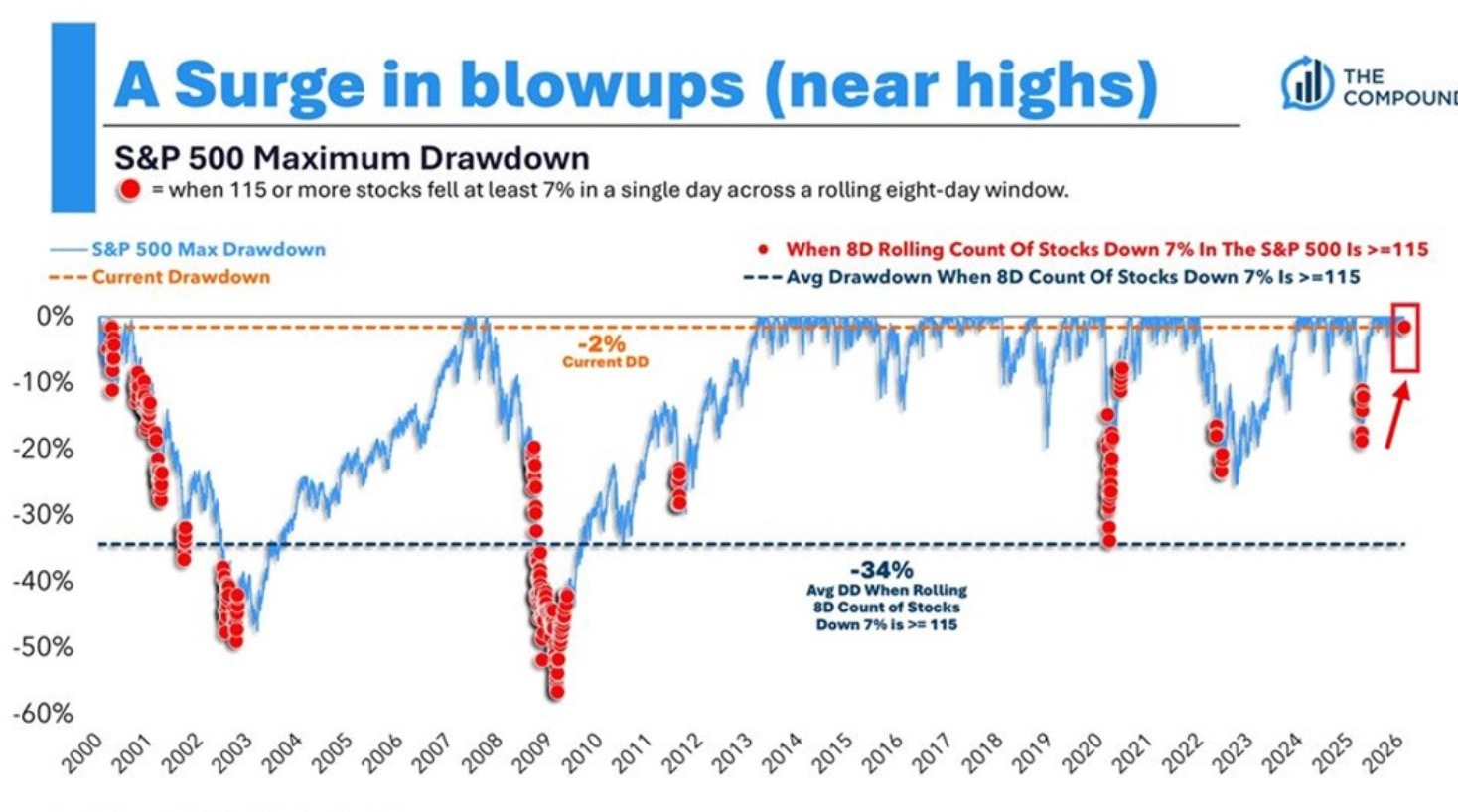
S&P 500 Maximum Drawdown - Historical context for today's warning signals
How Can the Market Crash at All-Time Highs?
This is the part that confuses most people. They look at the S&P 500 chart, see it near record levels, and think everything must be fine. But that is an illusion.

Here is the reality: the S&P 500 is a market-cap weighted index. That means a handful of massive companies can drag the entire index higher even while hundreds of smaller components are falling apart. Right now, the top 10 stocks in the index account for over 35% of its total weight. That concentration is unprecedented.
The mega-cap technology companies, particularly those with significant exposure to artificial intelligence, are delivering real revenue and real profits. They are pulling the index up while the majority of stocks are quietly deteriorating underneath.
Think of it like a building with a beautiful facade. From the outside, it looks solid. But the foundation underneath is cracking. Eventually, the facade cannot hold up on its own.
The Concentration Problem
When a small group of stocks carries the entire index, any rotation out of those names can trigger a cascade. This is exactly what happened in 2000 when tech leadership finally broke down.
What Makes This Time Different (And What Does Not)
I want to be balanced here. Not everything about the current setup screams "crash incoming." The mega-cap leaders today are fundamentally different from the dot-com darlings of 2000. Back then, companies with zero revenue and questionable business models were trading at absurd valuations. Today, the leaders like Apple, Microsoft, Nvidia, and others are generating massive cash flows and have dominant market positions.
That said, the breadth deterioration is real. And history tells us that when this many stocks break down at once, something is wrong beneath the surface. You cannot just dismiss it because the index looks healthy.
The other factor that concerns me is the structural obsolescence risk. Many companies in the S&P 500 face a future where their core business models could be disrupted or replaced. This is not like 2008 where the problem was temporary and cyclical. Some of these companies may never recover their former relevance.
My Strategy: Options as a Cash Flow Engine
So what am I actually doing about all this? I'm not panicking. I'm not selling everything and hiding under my desk. But I am being very deliberate about my positioning.
I have moved a significant portion of my capital to cash. That is step one. Cash gives you optionality. It gives you the ability to act when everyone else is frozen with fear.
But I'm not just sitting in cash doing nothing. I'm using options strategies to generate consistent income while I wait for the market to show its hand. Specifically, I am selling premium on high-quality names where I would be comfortable owning shares at lower prices.
This is the beauty of options. You don't have to pick a direction. You don't have to time the crash perfectly. You can get paid while you wait, and then deploy capital aggressively when opportunities present themselves.
Why Positioning Beats Prediction
Look, I have been in this game long enough to know that nobody can consistently predict when a crash will happen. Not me. Not the talking heads on TV. Not the algorithms.
But here is what I have learned: you don't need to predict. You need to position. There is a massive difference between the two.
Predicting means you are making a bet on timing. You are saying "the crash will happen in March" or "we have six more months of upside." That is a losing game over the long run.
Positioning means you are ready for multiple outcomes. If the market crashes, you have cash to deploy. If it keeps grinding higher, you are still generating income through options. If it goes sideways, you are collecting premium and building your war chest.
That is the edge. Not being right about direction, but being prepared for whatever happens next.
The Opportunity on the Other Side
Here is what gets me genuinely excited. If we do get a significant pullback, the buying opportunity could be generational. The strong companies I mentioned earlier, the mega-caps delivering real results, those stocks are not going away. If anything, a crash would let you buy them at a massive discount.
Every major crash in history has created millionaires on the other side. The people who had cash, had conviction, and had a plan were the ones who built life-changing wealth during the recovery.
I'm not hoping for a crash. But I'm certainly preparing for one. And if it comes, I will be ready to act aggressively on the strongest names in the market.
🎯 The Bottom Line
The 115-stock blowup signal is real. It has preceded two of the worst crashes in modern history. But crashes also create the best buying opportunities. The key is having cash, having a strategy, and having the discipline to execute when the time comes.
🎯 Key Takeaways
- 115+ S&P 500 stocks dropping 7% in a week is a historically significant crash precursor
- The same signal appeared before the 2000 and 2008 crashes, each leading to 34%+ drawdowns
- Mega-cap stocks are masking broader market weakness through index concentration
- Options strategies allow you to generate cash flow while staying positioned for opportunity
- Positioning for multiple outcomes always beats trying to predict timing