Iron Condors in 2026: Cash Flow from Chop
By Cash Flow University · · 9 min read
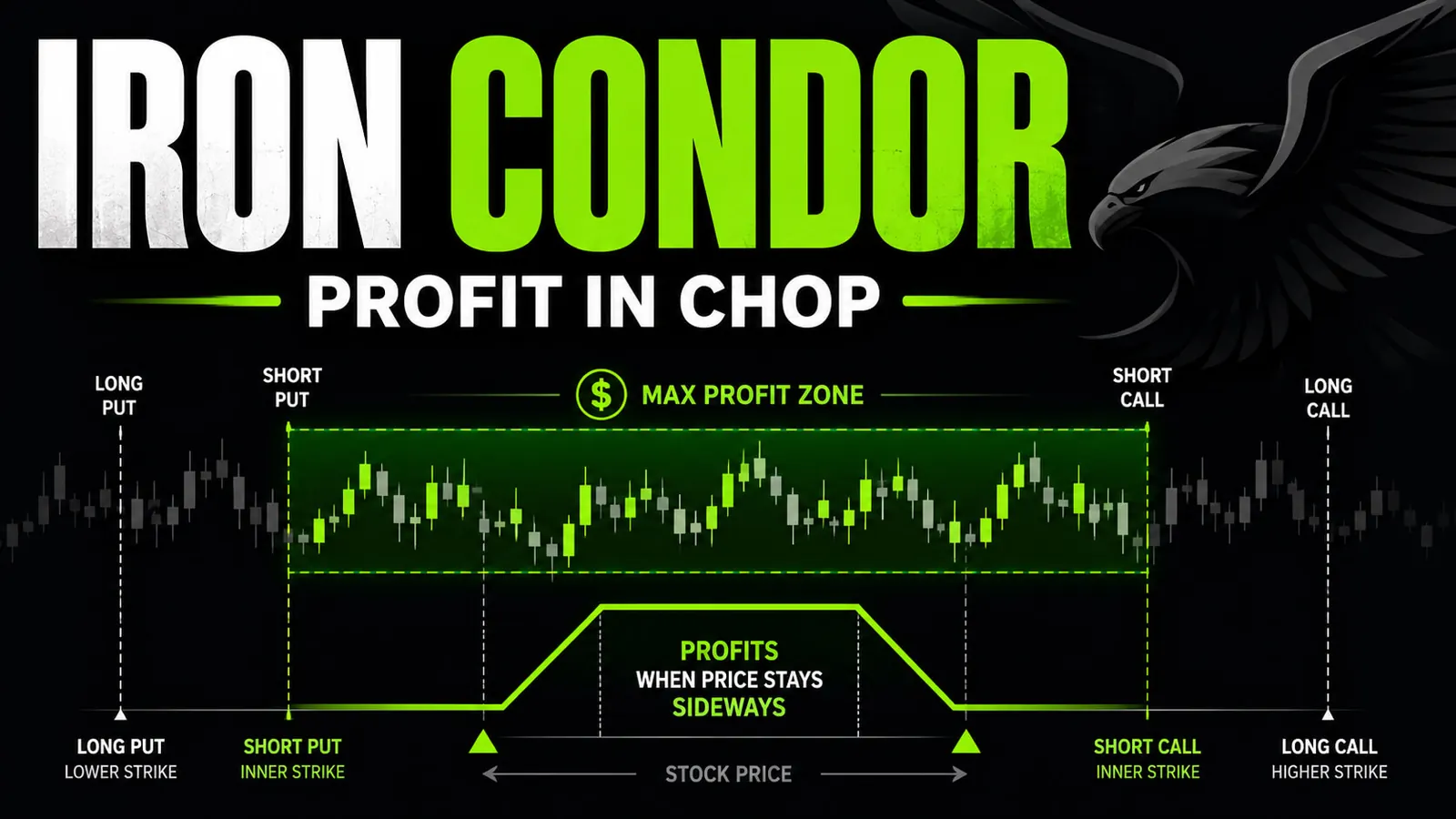
I show exactly how I build and manage iron condors in 2026—entries, exits, risk rules, and real SPY numbers—to turn sideways markets into consistent premium.
Last updated: May 7, 2026
Iron Condor Strategy: How I Profit When the Market Goes Nowhere in 2026
Fast money does not need a directional call. I get paid when price goes nowhere. This happens in a choppy 2026 tape where markets grind sideways. I use the iron condor. It is a strategy built on defined risk and systematic premium collection. It provides a repeatable statistical edge.
Table of Contents
- The Counterintuitive Way to Make Money Fast
- What an Iron Condor Actually Is
- Why Sideways Markets Are a Cash Flow Opportunity
- How to Build an Iron Condor Step by Step
- The Greeks: Your Iron Condor Dashboard
- The "Theta Clock" Rule: When to Enter and Exit
- What Can Go Wrong and How to Manage It
- Advanced Iron Condor Techniques
- Iron Condor vs. Other Sideways Strategies
- FAQs
- Start Collecting Premium, Not Predictions
The Counterintuitive Way to Make Money Fast
The fastest profits often come from the slowest markets. Most traders lose capital chasing direction. I sell time. My most consistent cash flow comes when the market drifts inside a range. The 2026 market shows volatility spikes followed by long stretches of consolidation. The iron condor is an essential tool for this environment.
"We want to trade small and trade often. The house doesn't go for a grand slam, they grind you with small, consistent edges." – Tom Sosnoff, Founder of tastytrade
This is the essence of the iron condor. We do not predict where the market goes. We find where it will likely not go. We collect premium for taking that defined risk.
What an Iron Condor Actually Is
An iron condor is a defined-risk, four-leg options strategy. It profits if the asset stays inside a price range through expiration. It combines two vertical credit spreads. You sell one put spread below the price. You sell one call spread above it. You bet on stillness. You profit from time decay.
Here is the anatomy of the trade:
- The Bear Call Credit Spread (The Upper Boundary): You sell an out-of-the-money (OTM) call. You buy a further OTM call. This creates a ceiling. It caps your upside risk.
- The Bull Put Credit Spread (The Lower Boundary): You sell an OTM put. You buy a further OTM put. This creates a floor. It caps your downside risk.
These spreads form the condor. You sell two options and buy two cheaper ones. You collect a net credit upfront. This credit is your maximum profit. Keep the entire premium if the price stays between your short strikes at expiration.
Why Sideways Markets Are a Cash Flow Opportunity
A sideways market offers opportunity because implied volatility often overstates actual movement. This creates an edge for sellers. Fear keeps option prices elevated during consolidation. The iron condor captures this volatility risk premium.
Theta (time decay) drives this strategy. Quiet days bleed value from the options you sold. You want this erosion to work for you. CBOE data shows about 75% of options expire worthless. We sell options to benefit from this fact.
Imagine a stock trades at $150. It stays between $140 and $160 for weeks. Volatility remains high. This is a prime setup. I expect it to hold between $135 and $165 for the next 30 to 40 days. That is my cash flow opportunity.
How to Build an Iron Condor Step by Step
Building a high-probability condor requires a mechanical process. Focus on expiration, delta, and risk. Use liquid assets like SPY and QQQ. Keep bid-ask spreads tight.
- Pick the Right Underlying. Look for high liquidity. Check for an IV Rank above 30. Tight spreads protect your edge.
- Choose the Optimal Expiration. Target 21–45 DTE (Days to Expiration). This window has high theta decay. Gamma risk stays manageable.
- Set Your Short Strikes Using Delta. Sell the call and put at 16 delta. This strike is about one standard deviation away. You have an 84% statistical probability of success.
- Define Your Risk by Buying Wings. Buy long strikes $5 to $10 wide. This width sets your max loss. A $5 spread caps loss at $500 per contract minus credit.
- Collect the Premium. Target a credit of $2.50 to $3.33 on a $10-wide SPY condor. This is 25-33% of the width.
Concrete SPY Setup
- SPY trading at $520
- Sell the $545 Call (16 delta) / Buy the $555 Call ($10 wide)
- Sell the $495 Put (16 delta) / Buy the $485 Put ($10 wide)
- Net credit collected: $2.80 per share ($280 per contract)
- Max loss: $7.20 per share ($720 per contract)
- Breakeven Prices: $492.20 and $547.80
The Greeks: Your Iron Condor Dashboard
Greeks are non-negotiable for managing trades. They measure sensitivity to market changes. Use them as your risk dashboard.
Delta: Keep it Neutral
Position delta should stay near zero. A high delta means you have a directional bet. That defeats the strategy. Change in delta shows which side is under pressure.
Theta: Your Best Friend
Theta is the rate of time decay. Iron condors have positive theta. You profit from the passage of time. 45 DTE is optimal. Theta decay accelerates here. You collect the most rent per day.
Vega: The Source of Your Edge (and Risk)
Vega measures sensitivity to volatility. You have negative vega. You profit when IV drops. This is why we sell high IV. A sudden IV spike will cause a temporary loss.
Gamma: The Late-Cycle Danger
Gamma is the change in delta. It adds risk near expiration. Small price moves can cause big losses. We exit at 21 DTE to avoid this risk. The final pennies are not worth the danger.
The "Theta Clock" Rule: When to Enter and Exit
Mechanical exits ensure consistent profits. Use profit targets and time. Do not use emotion. Managing winners early is critical for success.
Our rules are simple:
- Entry Window: Enter between 21–45 DTE.
- Profit Target: Close at 50% of max credit.
- Time-Based Exit: Exit at 21 DTE regardless of profit.
Holding for 100% profit ties up capital. It increases gamma risk. Taking 50% in two weeks is efficient. It is safer than waiting 45 days for the last few dollars.
What Can Go Wrong and How to Manage It
The primary risk is a strong move breaching a short strike. Do not get complacent. Respond systematically to dangers.
- Earnings Gaps: Earnings can cause 20% jumps. Rule: Never hold through earnings.
- Volatility Spikes (Vega Risk): Market crashes spike IV. This raises option prices. You may see a loss even if the price is in range. Keep position sizes small.
- Directional Grinds: A slow drift toward a strike is dangerous. It tempts you to wait. Follow your stop-loss rules.
Adjustment Scenario: Rolling the Untested Side
This is a common adjustment. SPY is at $520. You have a $495 put spread and a $545 call spread. SPY rallies to $535. The calls are under pressure.
- Identify the untested side: The $495 put spread is now far OTM. It has lost value.
- Roll it up for credit: Close the old put spread. Sell a new one at $515. Collect more credit.
- The results: Extra credit widens your breakeven. It reduces total risk. You use the safe side to defend the losing side.
You can also close the threatened side for a small loss. Or flatten the position if the trend is too strong.
Advanced Iron Condor Techniques
Experienced traders adapt the condor for different risks. Master the standard setup first. Then explore these variations.
- Playing the Skew: Puts often cost more than calls. This is volatility skew. You can make put wings wider. Or move the short put further out to 12 delta.
- Broken Wing Condors: Collect less credit on one side for more room. This creates a directional bias. If bullish, move the put spread closer to the money.
- Index vs. ETF Condors: SPX and RUT offer advantages. They are cash-settled. They have better tax treatment under Section 1256.
Iron Condor vs. Other Sideways Strategies
| Strategy | Max Profit | Max Loss | Capital Required | Best For |
|---|---|---|---|---|
| Iron Condor | Net credit | Width minus credit | Low | Range, high IV |
| Short Straddle | Net credit | Unlimited | Very High | Extreme IV, experts |
| Short Strangle | Net credit | Unlimited | High | High IV |
| Covered Call | Limited | Substantial | Very High | Mild bullish income |
| Calendar Spread | Limited | Debit paid | Moderate | Low IV |
The iron condor offers capital efficiency and defined risk. I know my max loss before the trade starts. This saves your career from one mistake.
See real trades on the CFU blog: joincfu.com/blog.
FAQs
What is an iron condor?
It is a "profit tent." You sell a call spread above and a put spread below. You collect money. If the price stays in the tent, you keep the cash.
How much can I make?
Your profit is the net credit. If you collect $2.80, you make $280. We aim to take 50% profit at $140.
When should I avoid it?
Avoid earnings reports. Avoid markets with very low volatility (IV Rank under 20). Avoid strong trending markets.
Can I lose more than the max loss?
It is nearly impossible with liquid ETFs. Close at 21 DTE to eliminate assignment risk. This risk only matters for illiquid stocks held to the last day.
How do I pick strikes?
Use 16-delta for short strikes. This provides a buffer. Buy wings $5 to $10 wide.
Is it good for beginners?
It is intermediate. Master single credit spreads first. Learn risk and the Greeks before using four legs.
What are the best assets?
Use high-liquidity ETFs. SPY, QQQ, and IWM are best. Stick to large-cap stocks with liquid chains and high IV Rank.
Start Collecting Premium, Not Predictions
The condor flips the script. Do not predict direction. Find where the stock will likely not go. Get paid to wait. This is a systematic business plan. It has defined risk and a statistical edge.
Learn our structure at joincfu.com. We provide alerts and rules for our community.